Mother in a Wheelchair: 6 Years of a Heartbreaking Secret
For six years, I believed I knew everything about my mother in a wheelchair, from her medications to every curb she struggled with. Then a stranger kicked her chair in a crowded department store, and a faded piece of paper fell from her pocket. It changed how I saw the worst day of our lives.
A Birthday Errand That Turned Ugly
Mom was 80 years old, and she had not walked in six years. We went to the department store for one simple reason. My daughter Mia was about to turn 12, and Mom wanted to choose the birthday present herself.
I kept steering her toward displays I thought she would like. Each time, she politely reminded me that she could find her own way.
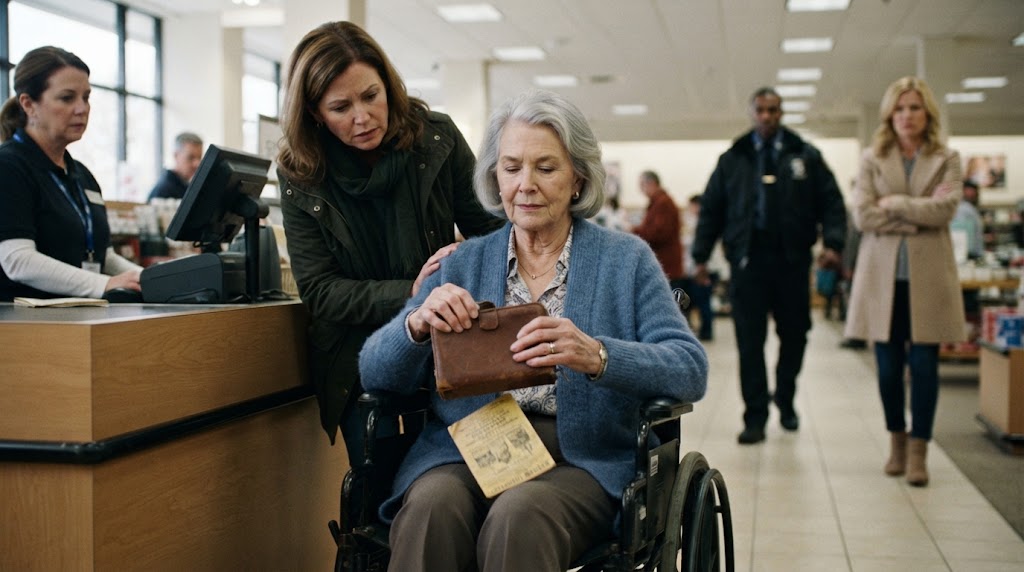
Then a woman started following us. For about ten minutes, she muttered that some people will do anything to get special treatment. She seemed convinced that a mother in a wheelchair was somehow running a scam.
At the accessible checkout, she raised her voice and accused Mom of faking. Mom didn’t answer. Her silence only made the woman angrier.
Then the woman kicked the wheelchair hard enough to lift the front wheels. Mom grabbed the armrests and steadied herself. The woman pointed and claimed this proved Mom could move whenever she wanted.
Why a Mother in a Wheelchair Became a Target
I stepped between them and told her not to touch my mother again. She crossed her arms and insisted Mom stop pretending. By now, half the store was watching.
A security guard came over and asked the woman to calm down. She demanded that he make Mom stand up. My hands were shaking. Mom’s were completely still.
People often think they can judge a disability at a glance. When they see a mother in a wheelchair shift her weight or grip an armrest, some decide the whole thing must be an act.
Mom reached into her cardigan pocket and took out a worn brown leather case. It held her medical details, emergency contacts, and the ID she sometimes needs when traveling. She said, calmly, that this might settle the matter.
As she opened it, a small folded paper slipped out and landed against my shoe.
A Faded Program From a Spring Concert
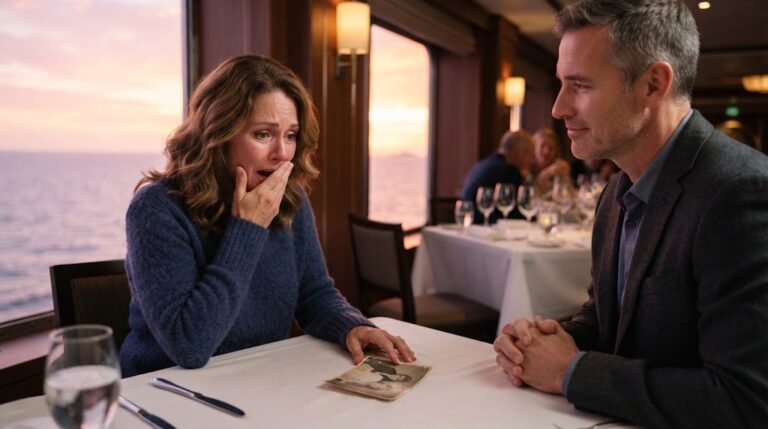
It was a program from Mia’s spring concert six years earlier. I recognized the school emblem and the crooked purple circle Mia had drawn around her own name when she was 6.
Mia had brought it to Grandma’s house three days before the concert. Mom had promised to keep it safe. I had no idea my mother in a wheelchair had been carrying a child’s drawing to every appointment and errand since then.
There was handwriting on the back. I had barely read the first three words when someone grabbed my sweater from behind.
A Lockdown Nobody Expected
It was the same woman. Her face had gone white. Her basket dropped, a jar shattered, and she stared toward the entrance in shock.
Then her knees gave out. The guard caught her, but not before she raised a trembling hand toward a man in a loose gray shirt near the front doors. Beneath his shirt, something dark and angular showed for a moment. It was a concealed weapon.
The guard spoke quietly into his radio. Seconds later, the overhead speakers ordered employees to lock the front doors. The man reached under his shirt, someone shouted for everyone to get down, and the store fell into chaos.
People dropped behind counters. A rack of scarves crashed over. And there sat my mother in a wheelchair, fully exposed in the middle of the aisle.
When Love Quietly Turns Into Control
I grabbed the handles. Mom said she could move herself. I begged her to let me do it, just this once, and started pushing.
The woman who had accused her shoved past us, trying to squeeze around the chair. I pointed her to the open space on the other side, and she hurried off.
I aimed for a glowing green exit sign. Mom said it was the wrong way. I didn’t listen. Six years earlier, I had stood beside her wrecked car while paramedics lifted her onto a stretcher, and I had sworn I would never feel that helpless again.
But that corridor led toward the front of the store, straight toward the man in gray. One wheel struck a metal table leg, and Mom gasped. Then she told me, firmly, that I was not listening to her.
Her voice wasn’t loud. It didn’t need to be. For a moment, I heard my own voice from six years before, begging her to change her mind. So I stopped and asked her which way we should go.
Pushing a mother in a wheelchair can feel like protection. In that moment, I saw how it could also take away the one thing she still controlled.
Following Her Lead to Safety
Mom pointed to a young cashier opening a narrow staff passage and waving people through in small groups. The armed man couldn’t see it from where he stood.
I let go. Mom turned her own wheels and asked me to stay beside her, not behind her. She guided the chair through a gap between stacked boxes without touching either side.
Watching my mother in a wheelchair move through that tight space, I realized she had been reading rooms like this for years. I just had never let her show me.
A security employee waved us toward an open emergency exit. A crash and shouting rang out behind us. I flinched, but Mom kept rolling.
Outside, staff guided customers behind a concrete wall. Someone called an ambulance for the woman who had fainted. Mom stopped beside a loading bay.
I asked if she was hurt, especially her shoulder. She admitted she was frightened, but said being frightened did not mean she was broken.
Sirens arrived. We waited behind the wall, holding hands, and I squeezed so hard she had to tell me I was hurting her fingers. At last, an officer told us the man had been arrested and we were safe.
What My Mother in a Wheelchair Wrote in the Hospital
Only then did I realize I was crying. Mom wiped my cheek and said I always looked at her as if she might disappear. Then she noticed my pocket and thanked me for saving her paper.
I asked why she still had it. She looked surprised by the question. Mia had given it to her, she said, and that was reason enough.
She let me read the back. Beneath a date from her hospital recovery were five short lines. She wrote that she never got to hear Mia sing that day and had grieved all she lost. Then Mia came and sang the whole song beside her hospital bed, and Mom wrote that she was grateful she hadn’t missed a lifetime of moments like that.
I remembered Mia in her yellow school dress, too scared to touch Grandma’s bandaged hand. So she sang instead, softly at first, then louder when Mom smiled.
I had been standing by the door that day, yet I had forgotten that smile. For six years, my memories held only the crash, the hospital hallway, and everything Mom could no longer do.
She told me she kept the note in her medical case because she was afraid of forgetting that losing something is not the same as losing everything. I had spent years seeing a mother in a wheelchair. She had spent those same years seeing a life still worth loving.
The Guilt I Carried for 6 Years
Then I told her what I had never said out loud. On the morning of the concert, she had called to say she had a headache, hadn’t slept, and wanted to stay home.
I wouldn’t let it go. I told her Mia would be heartbroken and that it was only one small trip. I made her feel guilty until she agreed and got into her car.
Another driver ran a red light. Still, I had always believed that if I had let her stay home, she would never have been at that intersection.
I told her I had thought about it every single day. Without realizing it, caring for my mother in a wheelchair had become my way of paying for that morning.
She looked at me as though I had confessed to carrying a stone in my chest. In a way, I had.
Choice, Grief, and Honest Love
Mom didn’t pretend it was nothing. She said what happened had changed her life. Then she reminded me that I was not the one who drove through that light.
I said I had pressured her. She said I had wanted my mother to hear her granddaughter sing. She had said no, then changed her mind because she loved that little girl. I had not stolen her choice.
She admitted she misses her garden, dancing in the kitchen, and standing up without a second thought. She said she was allowed to miss those things and still love the life she has. To her, being a mother in a wheelchair never cancelled out being a whole person.
She described Mia shaking at that hospital bed, convinced that singing every note perfectly would make Grandma better. Mom laughed through her tears and said she never cared about the notes.
I admitted that in the store, I had almost pushed her toward danger. She agreed. She knew I was trying to help, but she asked me to sometimes ask first.
I told her I kept thinking I could stop something terrible from happening again. She said neither of us could promise that. But we could stop fearing every ordinary day.
Lessons for Families Caring for a Mother in a Wheelchair
Our story isn’t a guide, but it taught me things I wish I had learned sooner. If you love a mother in a wheelchair, these lessons may help you too.
- Ask before you push. Her chair is part of her independence, not a handle for your fear.
- Let her lead when she knows the way. Mom found the safe exit while I panicked toward danger.
- Separate love from fear. Constant hovering can feel like care while slowly shrinking someone’s world.
- Say the hard thing. Guilt kept in silence only grows heavier with time.
- Remember what remains. Loss is real, but it is never the whole story.
Respect matters in public spaces, too. The U.S. Department of Justice explains disability access rights at ADA.gov, a helpful resource for anyone who has watched a stranger question a mother in a wheelchair.
Families under strain often face painful conversations about guilt, caregiving, and the relationships that hold them together. You can find more real-life stories and practical guidance at Divorce Matters Today.
Crossing the Street Together
When the doors reopened, the woman from the checkout was arguing with the guard, insisting she had done nothing wrong. She spotted Mom and pointed again.
The manager said security footage showed her kicking the wheelchair, and told her she was no longer welcome in the store. The guard walked her away.
I asked Mom if she wanted to report her. Maybe, she said, but right now she would rather buy her granddaughter a birthday present. I laughed in surprise. She said that mattered even more after a day like this.
My hands drifted toward the handles, then stopped. I asked if she wanted me to push. She said not yet, and wheeled herself toward a small music shop across the street.
At the crossing, we both watched the traffic. When the light changed, she moved first, and I stayed at her side.
Six years ago, Mia circled her name so Grandma could find her on a crowded stage. Grandma never reached that stage, but Mia found her anyway, in a hospital room. Walking beside my mother in a wheelchair that afternoon, I finally remembered the singing, not just the crash.