Mother’s Secret Letters: 11 Heartbreaking Notes Never Sent
Every family keeps a few secrets, but some secrets quietly rearrange entire lives. For Annie, the truth arrived in a quiet bedroom, with a hairbrush in her hand, and it led her straight to her mother’s secret letters, hidden away for almost three decades.
Her mother, Ruth, is 71 and living with Alzheimer’s. Most days, Ruth believes she’s somewhere in the past, and she no longer recognizes the grown woman who makes her breakfast as the daughter she keeps asking about. Annie had no idea that her mother’s secret letters held answers she had needed since childhood.
A Daughter Who Became a Stranger
When Annie first arrived to help, Ruth introduced herself politely and asked if she was the girl hired to look after her. Annie gave her name. Ruth lit up and said her own daughter had that same lovely name.
Annie smiled through the sting. She had learned that correcting her mother only caused confusion, so she let herself become “the helper” who happened to share a name with Ruth’s little girl.
Sometimes Ruth asked whether Annie had finished her homework. Other times, she fretted that her daughter was late coming home from school. She never connected those worries to the woman sitting right beside her.
Why Annie Came Home After So Many Years
Annie hadn’t planned to become her mother’s caregiver. For years, her father, David, had told her that her visits upset Ruth, and she had slowly accepted being kept at a distance.
Then, three months ago, Ruth’s longtime nurse, Linda, resigned. David was 74 and worn out. He finally called Annie and told her that her mother needed her now.
Annie almost laughed at the irony. She had needed her mother for most of her life. Still, she came, and nobody knew that this choice would eventually uncover her mother’s secret letters.
The early weeks were hard. Ruth sometimes refused her medication, lost her slippers, or asked the same question again and again within an hour. All the while, her mother’s secret letters sat untouched in the same house.
The Braid That Opened a Door
Then Annie noticed something small but powerful. Brushing Ruth’s hair calmed her almost instantly.
It made sense. When Annie was a child, Ruth used to sit her down before school and patiently braid her hair in three neat sections. Afterward, little Annie would turn around and pretend to braid her mother’s hair, while Ruth promised she’d improve with practice.
So one afternoon, Annie asked if she could braid Ruth’s hair. Ruth handed over the brush right away, adding a playful condition that Annie not pull. Annie laughed and agreed.
Halfway through, Ruth caught her eye in the mirror and asked her name again. When Annie told her, Ruth nodded and said it was just like her own girl’s.
That was when the memories crashed in. Annie remembered the kiss on the top of her head after every braid and the way her mother used to watch from the front door until she was out of sight. She also remembered the day all of it suddenly stopped.
Long before she ever heard about her mother’s secret letters, those small rituals were what Annie had held on to.
A Whispered Confession in the Mirror
A tear fell onto Ruth’s shoulder. Ruth asked why she was crying, and Annie admitted she missed her mom.
Ruth reached for her hand. Then she offered to share a secret, on one condition: Annie had to promise not to tell Ruth’s daughter.
Annie nearly dropped the brush. She promised. Ruth glanced toward the door and confided that she believed her husband was having an affair with her nurse.
Annie went cold. She knew exactly what her mother meant, because she had seen it with her own eyes when she was 14.
What Annie Saw at 14
That day, school had let out early because of a power outage. Annie walked into the house and heard Linda laughing in the kitchen.
When she reached the doorway, she saw Linda with her arms around David’s neck. Then her father kissed the nurse. Linda spotted Annie and jumped back so fast she knocked a spoon off the counter.
Annie asked her father why he had kissed Linda. David insisted she had misunderstood. He claimed Linda was stressed about Ruth’s care and he was only comforting her, and Linda backed him up.
At the time, Ruth was battling a health condition that left her exhausted and often bedridden. The house already felt unsteady. Annie didn’t want her father to become one more thing she couldn’t trust, so she accepted his story.
David added one more request. He asked her not to upset her mother with any of it, since Ruth wasn’t well enough for misunderstandings. That promise of silence would shape the next 28 years, and it would later help keep her mother’s secret letters buried.
The Secret Ruth Never Got to Share
The next morning, Ruth was having a good day. She braided Annie’s hair with her old confidence, and at the school gate, she held onto Annie’s backpack and told her to come straight home. Ruth had a secret, and she wanted Annie to hear it first.
Annie spent the whole day curious. But when she got home, David was waiting on the porch. It was the first door closed between them, and her mother’s secret letters would later meet the same fate.
He said Ruth had had a hard afternoon and had become upset when Annie’s name came up. He suggested that seeing Annie made her mother anxious and that loving someone sometimes meant giving them space.
That night, Annie heard her mother talking with Linda behind the bedroom door. When she knocked, the voices went silent. David appeared and told her not to disturb Ruth now that she was finally calm.
Annie went to bed without saying good night. The next day, Linda told her Ruth had slept better and that short visits were best. Annie believed her. Linda was the nurse, and Annie was only a scared teenager.
Locked Doors and Unanswered Notes
The distance grew gradually. At first, Annie was allowed 15 minutes with her mother after school. Then Linda started saying Ruth was too tired. Sometimes the bedroom door was locked.
Whenever Annie pushed back, David reminded her how serious Ruth’s illness was and asked whether she wanted to make her mother worse. Of course she didn’t.
So Annie began leaving notes outside the door. She wrote that she loved her mom, that she’d earned an A on a history test, and that she missed their Saturday pancakes. Linda sometimes claimed she read them aloud, but no reply ever came.
By 16, Annie had stopped knocking. By 18, she had convinced herself that her mother was happier without her. She left for college and built a life far from that house, never imagining her mother’s secret letters existed at all.
Her visits home were always scheduled around Ruth’s rest periods. Some lasted only minutes. Other times, she drove away without seeing her mother at all. Each rushed visit was another lost chance to learn about her mother’s secret letters.
An Aunt Who Asked the Right Questions
Aunt Margaret never fully accepted the arrangement. She reminded Annie that Ruth had always loved having her around and asked if she was sure her mother didn’t want visitors.
Annie repeated what David said about Ruth getting overwhelmed. Margaret frowned and remarked that David said a lot of things. Years later, that doubt would help uncover her mother’s secret letters.
Annie should have asked what she meant. Instead, she defended her father. He had spent years caring for her mother, and she felt he had earned her trust.
Much later, Ruth developed Alzheimer’s. By then, mother and daughter were limited to brief, awkward visits. David told Annie that Ruth often forgot who she was. Annie believed that, too, and eventually, it became true.
Ruth Finally Tells Her Side
Back in the bedroom, Ruth kept holding Annie’s hand. She said she had seen the way David looked at Linda. When she raised it, he told her she was imagining things. She didn’t believe him, but she had no proof.
Then Ruth said something that made Annie’s heart pound. Her daughter had once seen David and Linda together. David told the girl she’d misunderstood, and soon after, he began telling Ruth that visits were upsetting Annie.
According to Ruth, David said their daughter couldn’t stand to see her sick. At first, Ruth accepted it, thinking no child should have to watch her mother struggle. But she asked for Annie every single day.
David and Linda kept saying Annie needed time. Then the knocks on her door stopped, and Ruth assumed her daughter had given up on her.
Annie broke down. Through her tears, she asked whether Ruth had ever tried to reach her daughter. Ruth answered without hesitation. She had written letters, and David had promised to pass them along when Annie was ready.
Annie had never received a single one. Hearing about her mother’s secret letters for the first time, she realized how much had been taken from both of them.
Ruth said she had wanted her daughter to know that she believed her and that Annie had done nothing wrong. That was the message she had poured into her mother’s secret letters, yet every time Ruth asked to see her girl, David claimed Annie didn’t want to come.
Annie wrapped her arms around her mother and told her that Annie had never stopped loving her. When Ruth asked how she could know that, Annie said it was because she was Annie.
For one hopeful second, Ruth seemed to understand. Then she smiled kindly and said Annie had already told her that. Her Annie, she explained, was still a schoolgirl.
How Mother’s Secret Letters Came to Light
After Ruth fell asleep, Annie called Aunt Margaret and asked whether her mother had ever written to her.
Margaret was quiet for a moment. Then she remembered Ruth asking David to mail some letters after Annie left for college. David had told Margaret that Annie wasn’t answering them. It was the first outside proof that her mother’s secret letters were real.
Annie said she had never gotten them. Margaret’s voice turned firm. They needed to talk to David.
That evening, the two women walked into the kitchen together. David looked startled. Annie set her mother’s hairbrush on the table and told him she knew about Linda.
He froze and said it was a long time ago. That was all the confirmation Annie needed. He had made her believe she imagined it at 14, and he had let her think she was hurting her mother every time she tried to visit.
David argued that Ruth had been very sick and that Annie couldn’t understand those years. He even asked whether they really had to do this in front of his sister-in-law. Margaret made it clear that they did.
The Confession Behind Mother’s Secret Letters
When Annie brought up the letters, David first claimed he couldn’t remember. Then she told him Ruth remembered writing them, and his expression shifted.
He muttered that the letters wouldn’t have helped anything. Annie realized he had kept them all along. He admitted he thought it was better if she never read them.
Annie asked who it was better for. David finally confessed that he and Linda had made a mistake, that Ruth suspected it, and that he feared the family would fall apart if mother and daughter compared what they knew.
So he kept them apart. He said he never meant for it to last so long, but it did. Linda had helped in the beginning by telling Annie that visits were stressful. To Ruth, David said their daughter was frightened by her illness.
Annie told him he had watched the two of them miss each other for years. David insisted he had stayed and cared for Ruth instead of abandoning her. Annie replied that he had stayed in the house only to make sure she couldn’t be part of her mother’s life.
His eyes filled, and he said he was ashamed. Annie told him he had simply been afraid of getting caught. He didn’t argue. Yet his shame had never been enough to make him hand over her mother’s secret letters.
Reading Mother’s Secret Letters at Last
The next morning, David brought out a shoebox from the back of his closet. Inside were 11 envelopes. Some had yellowed with age, and others were addressed to Annie’s college dorm. Not one had ever been mailed.
With shaking hands, Annie opened the first of her mother’s secret letters. Ruth had written that she understood Annie might be frightened, but that her daughter never needed to protect her by staying away.
In that letter, Ruth said she loved Annie on her good days and her bad ones, whether she was strong enough to make breakfast or needed someone to bring hers. She begged Annie never to believe she was the cause of her sadness. The hardest part of being sick, Ruth wrote, was not getting to see her girl.
Annie couldn’t finish. Margaret sat with her until she could breathe normally again. Reading her mother’s secret letters felt like hearing Ruth’s voice from the lost years.
Drawing New Lines for Ruth’s Care
Now that her mother’s secret letters were finally in her hands, Annie refused to let David control the story any longer. She and Margaret made a plan together.
David would no longer decide when Annie could see Ruth or what she was told about her mother’s care. Margaret would help Annie arrange an independent review of Ruth’s needs and current care setup. David agreed to step back, knowing it was the only way Annie would stay involved.
That evening, Uncle Robert came over, and Annie shared everything David had admitted. For the first time, the family heard the truth from someone other than David, including how her mother’s secret letters had been hidden in a shoebox.
David tried to apologize. Annie told him she wasn’t ready to forgive him. Maybe one day she would be, but forgiveness could never return the years she and her mother had lost.
A Second Braid, and a Different Ending
The following morning, Annie carried the first of her mother’s secret letters into Ruth’s room. Ruth sat by the window, watching a bird on the fence, and asked warmly if Annie had come to help her today.
Annie sat down and offered to read her something. When she reached the part about missing a daughter, Ruth began to cry, feeling sorry for the poor woman who had written it.
Annie wiped her mother’s tears and said that woman had loved her daughter very much. Ruth agreed, then asked whether the daughter ever came back. Annie took her hand and said yes, and Ruth’s face softened with relief.
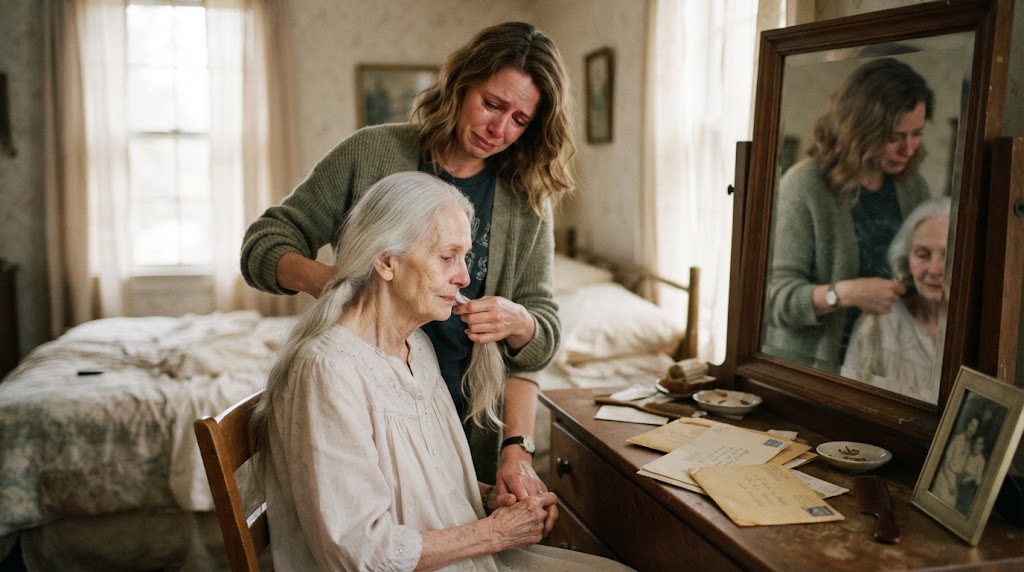
Annie turned the chair toward the mirror and picked up the brush. Ruth mentioned that her daughter used to love having her hair braided. Annie said she knew.
As Annie divided the silver hair into three sections, Ruth began humming the little tune she used to sing when Annie was small. Annie hadn’t heard it in years.
When the ribbon was tied, Ruth touched Annie’s hand and asked if her daughter knew she was loved. Annie kissed the top of her head, just as Ruth once did, and told her that her daughter knew now.
What This Family’s Story Teaches Us
Ruth didn’t say Annie’s name. She didn’t suddenly recover the decades that had slipped away. But she held her daughter’s hand, and this time, no one stood between them.
Stories like this remind us how easily trust can be twisted, especially when illness leaves a family vulnerable. Annie’s discovery of her mother’s secret letters shows how one person’s silence can steal years that never come back.
If you’re caring for a parent with dementia, the Alzheimer’s Association offers trusted guidance and support for families. For more real-life stories about broken trust, family conflict, and marriages under strain, visit Divorce Matters Today.
Could you forgive someone who kept you from a loved one for years? Annie is still deciding, but her mother’s secret letters finally gave her the truth she had been owed since she was 14.