White Birthday Candle: 15 Years of a Heartbreaking Secret
For 15 years, a single white birthday candle sat apart from the colorful ones on Audrey’s cake. This year it stayed unlit beside a dusty cardboard box, and the reason started with a letter her mother wrote before Audrey was born.
Audrey’s grandmother, Giselle, raised her from the day she came home from the hospital. How that candle finally came to rest says a lot about grief and love, and about the things children quietly carry for the adults around them.
A Tradition Born From Loss
Fifteen years earlier, Giselle drove her 24-year-old daughter, Hannah, to the hospital to give birth. Hannah joked for most of the ride, complaining that every pothole was out to get pregnant women. Then, about ten minutes away, she went quiet.
She asked her mother whether she would be any good at being a mom. Giselle told her she would be wonderful and promised to be there whenever Hannah needed her.
Giselle left that hospital holding her newborn granddaughter instead of her daughter. Hannah never came home.
Audrey’s father stayed for barely a week. He told Giselle that he saw Hannah every time he looked at the baby and couldn’t bear it. Then he left, and Giselle raised Audrey on her own.
Starting with Audrey’s first birthday, Giselle began a ritual. Before the regular candles were lit, she lit one plain white birthday candle for Hannah and shared a story or two about her.
When Audrey was little, Giselle helped guide her hand as she lit the white birthday candle. By nine, Audrey insisted on doing it herself. By ten, she was choosing the stories: the time Hannah backed into Grandpa’s mailbox, the time she turned the towels pink, and the time she tried to cook spaghetti without water.
The year Giselle forgot to buy matches, Audrey dug through the junk drawer until she found a half-used matchbook from an old restaurant. She told her grandmother that the white birthday candle could never be skipped. Giselle took that as proof the tradition meant as much to Audrey as it did to her.
The Box Hidden Behind the Closet Shelf
On the afternoon of Audrey’s 15th birthday party, Giselle had one task left. She needed the silver cake server, which had gone missing after the previous year’s celebration.
Audrey was at school, where her friends had covered her locker in streamers. After checking every drawer and cabinet she could think of, Giselle went upstairs to the room she still called Hannah’s.
Everyday life had slowly moved into that room. Winter coats filled half the closet, wrapping paper lived under the bed, and Audrey sometimes studied at the desk. Hannah’s yearbooks, stuffed rabbit, and ceramic earring bowl still sat untouched on the top shelf.
Giselle crouched by the bottom of the closet and shifted a stack of old magazines. The cake server wasn’t there. Behind the shelf, pressed against the wall, she found a small cardboard box covered in dust.
She assumed it held old photographs. Then she saw that the lid was addressed to Audrey in Hannah’s handwriting, with the y curling too far beneath the name, the way Hannah always wrote it.
Giselle sat down on the carpet and couldn’t open the box right away. Downstairs, the white birthday candle was already waiting on the counter beside fifteen pink and purple ones.
What Hannah’s Letter Really Said
Inside the box were a thick blue folder, a small white envelope, and a folded yellow sheet from the childbirth class Hannah took near the end of her pregnancy. The forms listed Giselle as emergency contact and as the person to make decisions if Hannah temporarily couldn’t. They also named her as the one Hannah trusted to care for Audrey if something unexpected happened.
Behind the forms was a folded page. Hannah had written it for the moment she might not be able to say these things herself.
The first sentence was traced darker than the rest, as if Hannah had gone over it twice. If Audrey ever asked whether her mother died because of her, Hannah wanted the answer to be no.
Hannah went on to apologize that her mother might be the one left holding everything together. She knew Giselle would work tirelessly to make sure Audrey felt loved by the mother she never met.
Then came a request that stopped Giselle cold. Hannah asked her never to tell Audrey that she had given her life for her. She was having her daughter because she wanted her, and if something went wrong, that was not a debt Audrey would owe.
For 15 years, Giselle had told Audrey many true things. Hannah loved her before she was born, Hannah was brave, and Hannah would have been proud of her.
But one sentence came up more often than any other: her mom gave her life. Giselle said it when Audrey asked why her mother died. She said it again when Audrey cried after a school Mother’s Day breakfast and when she wondered whether Hannah had been scared.
Giselle had always meant those words as love. She had never stopped to hear how they might sound to the child receiving them.
A Mother’s Wish That Changed the White Birthday Candle
The letter had one more section, and it sounded exactly like Hannah. Because she knew her mother well, she asked Giselle not to turn Audrey’s birthdays into a yearly memorial service.
She suggested better stories instead. Tell Audrey about getting kicked out of choir rehearsal for laughing and about hating tomatoes but eating ketchup. Tell her about the guy Hannah dated for three months because she couldn’t break up with him without hurting his feelings, and admit that her mother had been right about that one.
The final lines asked for something simple. Hannah wanted Audrey’s birthday to belong to Audrey.
Giselle stared at the page until the words stopped looking like handwriting. Every year since Audrey turned one, the white birthday candle had opened the celebration with a moment for Hannah, which was exactly what Hannah had hoped to avoid.
Her phone buzzed on the carpet. Audrey wanted to know if her friends Mia and Zoe could come at five instead of six, and she begged her grandmother to keep the baby pictures hidden.
Giselle agreed to the new time and teased that the photos were negotiable. Audrey called her a traitor and added a little devil emoji. Giselle smiled, then started crying so suddenly she had to put the phone down.
In that moment, Audrey stopped being a symbol. She was a 15-year-old who wanted loud friends, chocolate frosting, and some control over which embarrassing photos got shown.
Then Giselle thought about the cake waiting downstairs next to the white birthday candle. It was strawberry, Hannah’s favorite, as it had been every single year. Giselle could not remember ever asking Audrey what flavor she wanted.
The Conversation That Changed Everything
The front door slammed. School had let out early for teacher conferences, and Audrey ran upstairs still wearing a silver paper crown a classmate had given her.
She found her grandmother sitting on the floor and spotted the box. The teasing left her voice as she asked whether it had been her mom’s.
Giselle almost brushed it off, the way she usually did when something hurt too much. Instead, she held out the page and said it was written for both of them.
Audrey sat down beside her, their knees touching, and read slowly. Her eyes rested for a long time on the line about debt. When she reached the part about birthdays, she looked up at her grandmother without a word.
Audrey folded the page along its old crease and handed it back. Then she asked quietly whether the white birthday candle had already been bought.
Giselle said yes, and then asked why Audrey had never told her. Audrey’s small, knowing reaction frightened her more than an argument would have.
Audrey said she didn’t hate the tradition, and she understood why they did it. But she had noticed things. Her grandmother cried before breakfast every birthday and glanced at the clock around lunchtime, the hour Hannah died. Everyone also went silent for her mom right before she blew out her candles.
She said she knew it wasn’t her fault. Knowing that, though, didn’t stop it from feeling strange.
Then, in a much smaller voice, she asked how she was supposed to make a birthday wish on the day her grandmother lost her daughter. When Giselle asked what she usually wished for, Audrey admitted that mostly, she wished her mom hadn’t died.
Why the White Birthday Candle Finally Moved
Giselle realized that Hannah’s box had been hidden for 15 years, but Audrey’s secret had not been hidden at all. It had been right in front of her every birthday, sitting beside the white birthday candle.
She took Audrey’s hand and asked what she wanted that night. Audrey said she didn’t want to throw her mom’s candle away, and Giselle promised they wouldn’t.
Audrey had an idea. They could light the white birthday candle on Hannah’s birthday instead, and Giselle could tell her stories then, not hospital stories, just stories about her mom.
Giselle said she had plenty. Then Audrey made a confession: she hated strawberry cake.
She had eaten it for years because she thought it was important. Giselle laughed until she had to wipe her eyes, then asked what cake Audrey actually liked.
Audrey said chocolate. Giselle pointed out that Hannah had hated chocolate cake and nearly suggested vanilla. Then she stood up and said it was a good thing this wasn’t Hannah’s birthday.
A Birthday That Finally Belonged to Audrey
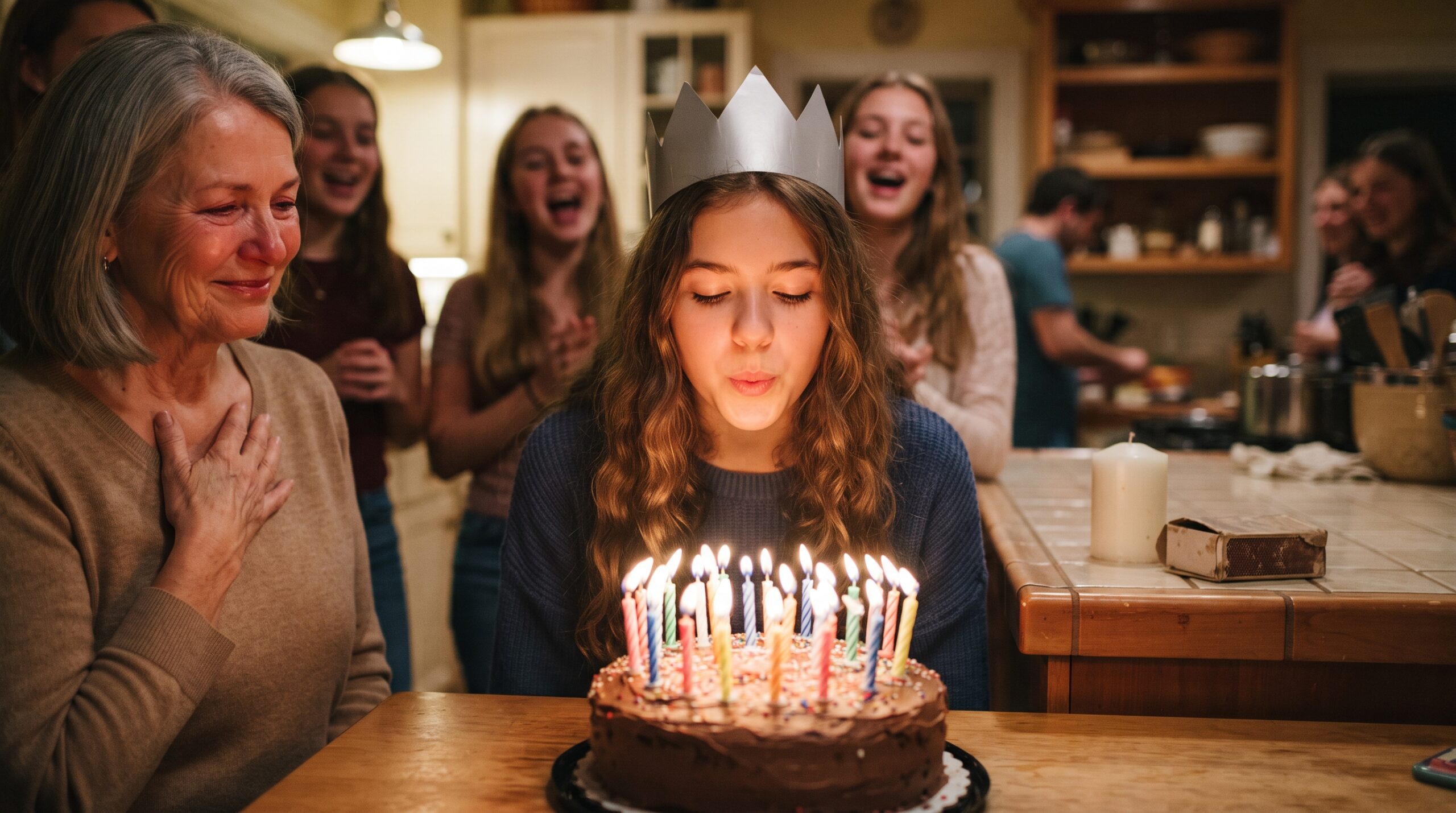
That evening, fifteen bright candles covered a chocolate cake that one of Audrey’s friends helped pick up. Everyone gathered around the table.
Out of habit, Giselle reached toward the counter for the white birthday candle. Her fingers touched it, and she stopped to look at her granddaughter.
Audrey said not tonight. She picked up the candle herself, set it beside Hannah’s box, and said they would need it on her mom’s birthday.
Her friends started singing. Nobody paused for a memorial story, and nobody checked the clock.
Audrey closed her eyes as the small flames lit her face, then blew them all out. For the first time in 15 years, Giselle didn’t ask her granddaughter what she had wished for.
What the White Birthday Candle Teaches Grieving Families
Grief rituals usually grow out of love, and the white birthday candle was no exception. Giselle created it to help Audrey know a mother she never got to meet.
Children often notice more than adults realize, though. Audrey saw the tears, the clock-watching, and the silence, and she carried all of it quietly rather than risk hurting her grandmother.
Hannah seemed to understand this before her daughter was born. She didn’t want her child to grow up feeling responsible for a loss she did nothing to cause.
For families raising a child after a loss, the lesson is gentle but important. Ask the child what they need, even about something as familiar as a white birthday candle, and be ready to hear an honest answer.
Sometimes the most loving choice is to separate a child’s special day from the grief attached to it. A loved one can still be honored on another date, in a way that celebrates who they were instead of how they were lost.
Families looking for support with childhood grief can find helpful resources at The Dougy Center, a nonprofit dedicated to grieving children, teens, and families. For more stories about family, loss, and the relationships that shape us, visit Divorce Matters Today.
Final Thoughts
Hannah’s letter asked for something simple, and Audrey finally received it: a birthday that was hers alone. The love for Hannah didn’t go anywhere. It moved to a better day, and the white birthday candle now waits for the one date that has always belonged to Hannah.