Ruined Dress: 1 Shocking Video Exposed a Sister’s Big Lie
A ruined dress does not usually end up in small claims court, and it rarely forces a whole family to look at itself. But for a 23-year-old waitress named Nora, a wine-stained gown stuffed into a plastic grocery bag was the last in a long line of things her younger stepsister had taken without a second thought.
What followed was a legal filing, a furious knock on the door, and a phone video that showed far more than anyone intended. By the time it was over, Nora had learned how to stop paying for someone else’s choices.
A Childhood Where Valerie Always Came First
Nora’s mother died giving birth to her. When Nora was five, her father married a woman named Diane, who arrived with a one-year-old daughter, Valerie.
The pattern showed up early. On Nora’s eighth birthday, the final slice of her own chocolate cake was handed to four-year-old Valerie because the little girl supposedly hadn’t had enough. When Nora objected, Diane told her not to be jealous.
Christmas followed the same script. Valerie opened carefully chosen presents, like a dollhouse with working lights and boots in her exact size. Nora usually got socks and a gift card picked up at a gas station.
At ten, she politely asked her father why things were so uneven. He told her she should learn to share, though she had been given nothing to share in the first place.
So she quit asking. Requesting fairness only earned her labels like selfish and ungrateful, and expecting nothing turned out to be quieter.
The Reliable One
As the girls grew up, Nora became the family’s fixer, long before there was a ruined dress to argue about. When Valerie made a mess, Nora was expected to help clean it up, and at sixteen she even covered for her after Valerie slipped out to a party.
Her father and stepmother praised her for being a good sister. Mostly, she was worn out.
By twenty-three she had finished college, moved into a small apartment, and started waiting tables while she searched for a more permanent job. Nobody had ever handed her money, so she watched every dollar, and her closet was filled with thrift-store finds and cheap online orders.
The Emerald Gown Before It Became a Ruined Dress
Then her best friend Priya got engaged, and Nora walked past a boutique window. Inside hung a deep emerald gown with a structured bodice and a skirt that seemed to flow like water. The price was close to $4,000.
She decided that just once in her life, she wanted to own something beautiful. For four months she worked every shift she could get, gave up her weekends, and skipped dinners out until a saleswoman finally wrapped the gown in tissue paper.
A week before the wedding, she brought it to her father’s house to show the family. She set her purse on a kitchen chair and carried the garment bag into the living room, never imagining she was only days away from holding a ruined dress.
Valerie, now nineteen and still living at home, ran her hand along the sleeve and asked to borrow it for a party. Nora said no. Valerie asked again two days later and got the same answer.
Then their father called. He reminded Nora that it was only one night and that Valerie was her sister, and he repeated the line she had heard since childhood about learning to share.
Valerie texted a promise to be careful. She described the event as a dull charity gala with her mother’s friends. Tired of being cast as the villain, Nora finally gave in.
How the Ruined Dress Came Home
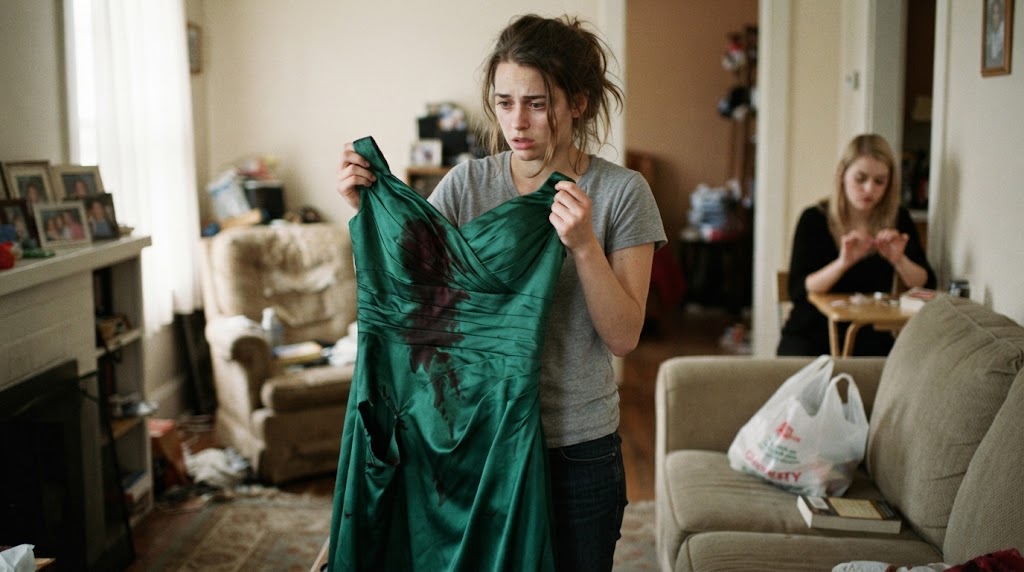
Two days later, Valerie dropped a plastic grocery bag on Nora’s couch. Inside was the gown, with red wine spread across the bodice, a tear at the hip, and a zipper hanging open with bent teeth.
Valerie called it an accident and told her not to be dramatic. When Nora said she would have to pay to fix or replace the ruined dress, her stepsister laughed and pointed out that she was nineteen and Nora was the one with a job.
Nora called her father and Diane that night, still hoping for fairness. They came over, and her father said Valerie simply did not have that kind of money. Diane could not believe anyone would start a family war over a piece of clothing.
Then her father told her not to be jealous, and something shifted. Nora had paid for that gown with double shifts and sore feet, yet she was the one being treated as petty for wanting her property respected. She calmly asked them to leave.
Building a Case Over a Ruined Dress
That night, Nora photographed every inch of the damage. She saved screenshots of Valerie’s texts and tracked down the receipt.
Then she opened her laptop. A little more than an hour later, she had filed a small claims case over the ruined dress and sent the confirmation to Valerie. She went to bed feeling calm for the first time in years.
The next morning, someone pounded on her door hard enough to rattle the frame. Valerie stood outside, shaking with anger and holding up her phone. She demanded that Nora withdraw the claim immediately, insisting that family does not do this to family.
Nora refused. Valerie’s expression changed, and she announced that there was more to the story than a ruined dress. She pushed inside, dropped onto the couch, and pulled up a video.
The Bridge Rescue
The clip showed a pedestrian bridge at night. Valerie’s friend Kayla, wearing a silver top, had climbed partway onto the railing with her arms stretched wide when her foot slipped and she tipped backward.
Valerie, in the emerald gown, lunged and caught her around the waist. Both of them crashed onto the concrete, and wine from a dropped cup sprayed across the green fabric, the stain that helped turn it into a ruined dress.
Nora was shaken. A young woman could have died that night, and her stepsister had pulled her back. Valerie, growing smug, wished her luck suing someone for saving a life.
For a moment, Nora believed the case over her ruined dress was finished. Then she noticed that the rescue sat near the very end of a much longer recording.
What the Rest of the Video Showed
Valerie insisted the earlier footage did not matter and lunged for the phone. Nora had already dragged the progress bar back and pressed play.
In the earlier part, Valerie bragged that her parents believed she was at the charity event and had no idea where she really was. The laughing voices around her belonged to friends her father and Diane had banned two years earlier after a shoplifting incident.
The scene then moved to a loud, flashy venue. Valerie climbed onto a bar stool and then onto the bar itself, spun in circles, sat in a puddle of something, and wiped her hands on the skirt. The damage to the ruined dress clearly had a longer history than one heroic moment.
Then came the worst part. A friend asked how she had gotten into a place that only admitted people twenty-one and over. Valerie grinned at the camera, held up Nora’s driver’s license, and announced that she was Nora for the night.
Nora watched that section twice. Next to it, a ruined dress suddenly seemed like the smallest problem in the room.
Valerie admitted she had taken the license from Nora’s purse at their father’s house. She swore she had only used it to get through the door, and said she took it because Nora would have refused.
Nora told her that was exactly the problem. Valerie had known the answer would be no, so she had taken away Nora’s chance to say it. It was the rule of their entire childhood, only this time Valerie had borrowed a whole identity.
An Offer Nora Refused
Realizing what the footage would mean at home, Valerie began to plead. She promised to cover every cent of the ruined dress if Nora dropped the case and kept the video away from their parents.
It was the outcome Nora had wanted from the start, and all it required was protecting Valerie one more time. She said no.
She would not trade her silence for payment. She also would not run to their father. Valerie was an adult, Nora told her, and she could tell them herself.
The Family Dinner
No call came that night. A few days later, though, her father invited Nora to what he called an important family dinner. Valerie was already at the table with puffy eyes, and both parents looked at Nora as if she were the one in trouble.
They said Valerie had told them everything. She had lied about the gala and gone out with the banned friends, but she had also saved a girl from a deadly fall. In their view, Nora could not possibly continue a lawsuit about a ruined dress after that.
Nora agreed that the rescue was brave. But she noticed what was missing from their version, and she saw that Valerie would not meet her eyes.
She told them there was more. When they pressed her to explain, she recognized the old routine in which Valerie caused the problem and Nora did all the explaining. This time she simply turned to her stepsister and waited.
After a long silence, Valerie whispered that she had taken Nora’s ID and used it to get into a club. She argued that nobody had been hurt and that none of it erased what she did on the bridge.
Nora agreed that it didn’t. Valerie had done something courageous, she said, and she had also stolen, lied, and worn another person’s name like a costume. Both things were true.
Nobody argued. For once, her father’s hard questions were aimed at Valerie instead.
A Sister, Not a Parent
Then he turned back and asked Nora what she thought they should do. She put down her fork and declined to answer.
Her part was simple, she explained. Valerie owed her for the ruined dress. Everything else was between two parents and the nineteen-year-old living under their roof. When Diane started to protest that the girls were sisters, Nora replied that this was the point. She was a sister, not a parent.
Valerie mumbled that she had already offered to pay. Nora corrected her, because that offer had been a payment for silence. She was accepting the money only because something that belonged to her had been destroyed.
Valerie proposed paying half the cost of the ruined dress right away from her savings and the rest in monthly installments. Nora told her to write it down, and Valerie put the agreement on a napkin and slid it across the table.
What a Ruined Dress Finally Changed
The first half reached Nora’s bank account two days later. When the final payment cleared that spring, she withdrew the small claims case without ever seeing a courtroom or a judge.
The filing had done its job. Documenting the ruined dress with photos, texts, and a receipt gave Nora something she had never had in that family, which was a position that did not depend on anyone’s approval.
Her story also carries a practical reminder. Using another person’s license, even for a single night, is no small thing, and anyone worried that their identity has been misused can find step-by-step help from the Federal Trade Commission at IdentityTheft.gov.
For more stories about family conflict, hard boundaries, and standing up for yourself, visit Divorce Matters Today.
In the end, the ruined dress mattered less than what it stood for. For once, Valerie had taken something that belonged to Nora, and Nora was not the one left to absorb the cost.