
Blue Kitchen Chair: 1 Heartbreaking Gift After 50 Years
Some objects are worth almost nothing and still carry an entire life. For a man named Gilbert, that object was a wobbly blue kitchen chair that stood at a crowded table in Hawaii for roughly 50 years, waiting for him to come back.
He never did. But two weeks after he died, the chair came to him anyway, packed in a huge box and left on a porch in Oregon. What his daughter Annie learned that day changed how she saw her father, her mother, and the quiet tension she had grown up around.
A Teenager Who Needed a Place at the Table
Gilbert was born in Hawaii. When he was a teenager, life in his childhood home became unstable. He never shared every detail, not even with his wife, but for several years he lived with a foster family.
The house was full. Kids came and went, shoes piled up by the door, and plates were always drying beside the sink. There were never enough matching chairs to go around the table.
So Gilbert ended up with the odd one out, an old wooden seat painted blue. Nobody officially gave it to him. The family simply started expecting him to sit there, at breakfast and at dinner, day after day.
That small habit meant a great deal to a boy who had not always known where he belonged. The blue kitchen chair was proof that when a meal was served, a spot had been saved for him. He used to joke that it leaned as much as he did, and at some point his name was carved in uneven letters underneath the seat.
Leaving Hawaii at 20
At 20, Gilbert got a chance to work on the mainland. No one pushed him out. His foster family encouraged him to take the opportunity, and he fully expected to return.
He moved to Oregon. One year turned into several. The job turned into a life, then a marriage, then a daughter named Annie.
Back in Hawaii, the house kept going without him. Other kids sat in the blue kitchen chair. At some point a leg broke, and the family repaired it with a darker piece of wood.
Whenever someone suggested getting rid of it, the woman who had raised him refused. To her, the blue kitchen chair still belonged to Gilbert, no matter who happened to be sitting in it.
Why He Never Went Back
Gilbert missed Hawaii out loud. When Annie was small, he talked about warm rain, fruit sold at roadside stands, and birds singing before sunrise. He told her you could smell the ocean before you ever saw it.
He also kept a faded beach photograph in the kitchen junk drawer, tucked among dead batteries and takeout menus. He took it out so often that his thumb wore one part of it nearly smooth.
Yet he never booked a flight. At first the reason was money. Later it was work. After that, the reason became harder to say.
The longer he stayed away, the more embarrassed he felt about staying away. Christmas cards arrived from Hawaii for years, and he answered some of them. But each card reminded him how much time had passed.
He convinced himself he had waited too long to show his face. He had no idea that the blue kitchen chair was still in that house, and still called his.
The Tension Annie Grew Up With
Annie noticed early that Hawaii was a touchy subject at home. Her dad would mention it, her mom would go quiet or leave the room, and someone would quickly change the subject.
Once, after Gilbert said he wanted to see that ocean again, her mother set her plate in the sink so hard it nearly cracked. Annie decided her mom was the reason he never went.
When she asked her father about it, he denied that her mother was angry. He told Annie that if she knew the whole story, she would not be upset with her mom. Annie did not ask what he meant, and she later wished she had.
The truth was more complicated. Early in the marriage, Gilbert compared everything to Hawaii: the rain, the fish, the coffee, the sunsets. Each time he called the islands home, his wife heard him saying that Oregon was not.
One night she snapped and said that if Hawaii was so perfect, maybe he should have stayed there. That was when he told her about the foster home. She realized she had not been competing with beaches and palm trees. She had been competing with a blue kitchen chair at the first table where he felt sure dinner would include him.
She apologized, and he forgave her right away. From then on, she spent years trying to get him to go back.
She brought it up when Annie was ten, and he said they could not afford it. She brought it up after his promotion, and he said work was too busy. She brought it up for their 25th anniversary, and he said the people he knew were probably gone.
They were not gone, and the cards proved it. One summer she offered to buy the ticket herself. He told her next year, and next year became another decade.
How the Blue Kitchen Chair Came to Oregon
Months before Gilbert died, his wife learned that the old house in Hawaii was being cleared. She still had an address from the Christmas cards, so she called one of the women he had grown up with.
She asked a question that must have sounded strange. Did anyone still have Gilbert’s seat from the kitchen table?
The woman laughed and said they still had the silly thing. Together they arranged to ship the blue kitchen chair across the ocean.
The plan was simple. She would set it at their own table, let him see it, and ask him one more time to go home. She hoped it would show him that he had not disappeared from those people’s lives just because he had stayed away.
The package left Honolulu. Three days later, Gilbert was driving home when another car crossed into his lane. He did not survive, and he never knew the blue kitchen chair was on its way.
The Package Nobody Wanted to Open
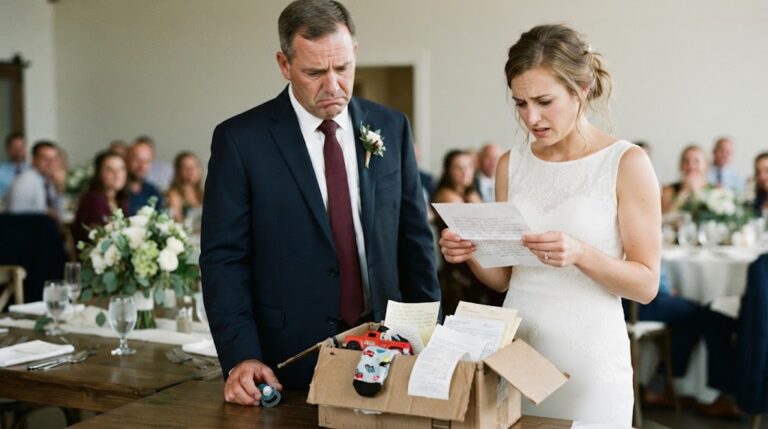
Two weeks after the accident, Annie and her mother were still sorting sympathy cards. His shoes were still by the garage door, and his jacket still hung on its hook. Then a delivery driver left an enormous box on the porch.
The label carried her father’s name, their address, and a Honolulu origin. The shipping date was three days before the crash. Annie dragged it inside.
Her mother’s reaction scared her more than the box did. She took one look at the label, grabbed Annie’s wrist, and pleaded with her to throw it away unopened and pretend it had never arrived.
Annie refused. Someone had mailed her father something huge just before he died, and that person might be waiting to hear from him. She cut the tape and pulled back the packing paper.
Inside was the blue kitchen chair. The paint was worn at the edges, one leg was patched with darker wood, and a black mark scarred the bottom rung, as if something hot had once been set against it. When she put it on the floor, it wobbled.
She tipped it over and found her father’s name carved into the underside, the grooves darkened with age. Her mother sat down and started to cry.
What the Blue Kitchen Chair Really Meant
Piece by piece, her mother told her everything: the foster family, the crowded house, the mismatched seat, the cards, the years of gentle pushing, and the phone call she had made.
Annie went to the junk drawer and took out the old photograph. For years she had seen only a gray ocean and leaning palm trees. Now she looked at the left edge, where a few tiny figures stood near a cooler: some teenagers, a woman, someone crouching in the sand.
That was the spot his thumb had worn smooth. He had not been staring at the beach at all. He had been looking at the people who gave him a blue kitchen chair and a place to belong.
Then Annie asked the hardest question. If her mother had arranged all of this, why beg her to throw it away?
Her mother’s answer was brief. He was supposed to be the one sitting in it. Looking at the blue kitchen chair without him was more than she could bear.
A Phone Call to Hawaii
A contact number was printed on the shipping label. Annie realized that somewhere in Hawaii, someone believed Gilbert had just gotten his blue kitchen chair back. She dialed.
After four rings, an older woman picked up. Annie introduced herself as Gilbert’s daughter, and the line went silent. The woman had never known he had a child.
Her name was Ruth. She had been fifteen when Gilbert arrived at the foster home, and she asked about him gently.
Did he still cheat at cards? Did he still hate papaya? Did he still whistle when he was nervous? The answer was yes every time, and Annie learned her father had lied to her about liking papaya. These were not stories about a hidden stranger. This was the same man she had always known.
Annie asked why they had held on to a blue kitchen chair for 50 years. Ruth seemed surprised by the question. It was Gilbert’s, she explained. Kids used it, it got broken and fixed, and their mother never let anyone toss it.
When Annie said her dad believed he had stayed away too long to come back, Ruth said nobody had ever told him that. Annie’s mother leaned toward the phone and asked whether Ruth had been angry with him.
Sometimes, Ruth admitted. But she still would have picked him up at the airport.
A New Place at the Table
A week later, Annie carried the blue kitchen chair to her own apartment and set it at her table. Her mother objected at first, because it was her husband’s.
The following Sunday, her mother came over for coffee and found Annie sitting in it. She paused, and Annie expected to be asked to move. Instead, her mom took the seat across from her.
The faded photograph lay between them. Her mother turned it around and pointed to the woman by the cooler. That, she said, was the woman who raised him.
The blue kitchen chair shifted and tapped unevenly against the floor, just as it always had. Outside, Oregon rain ran down the window. Annie stayed where she was.
What This Story Teaches About Family and Time
Gilbert’s story is not really about furniture. It is about how shame grows in silence. He loved those people and assumed the door had closed, while on the other side of the ocean a blue kitchen chair was being repaired and defended against every attempt to throw it out.
It is also about how easily couples misread each other. For years, Annie blamed her mother for something her mother was quietly trying to fix. One honest conversation early in the marriage had already turned jealousy into understanding.
Foster families shape lives in ways that can last for decades. For anyone who wants to understand how foster care works, or how to support the young people in it, the Child Welfare Information Gateway is a reliable place to start.
And if family strain, distance, or loss is part of your own life right now, you can find more stories and guidance at Divorce Matters Today.
If there is someone you have been meaning to call or visit, do not wait for a year when it feels easier. That year may never come. Somewhere, there may be a blue kitchen chair still waiting with your name on it.