Grandmother’s Skirt: 14-Year-Old’s Inspiring Act of Healing
On an ordinary school morning, a phone call pulled Mrs. Wilson away from work and into a quiet principal’s office. Her 14-year-old daughter, Emily, was sitting there in tears, unwilling to stand up, and nobody could quite explain why. What she would soon learn was that her late mother’s handmade garment, a grandmother’s skirt pulled from an old cedar chest, sat at the center of everything.
This is the story of a grandmother’s skirt, a teacher’s hurried words, and a family that had been grieving in silence for far too long.
A Call No Parent Wants to Get
Principal Harris kept his message short. Something had happened in Emily’s history class, she was crying, and she was asking for her mother to take her home.
Mrs. Wilson asked if her daughter was hurt. The principal couldn’t say much, only that it would be best if she came in person, so she left right away.
When she arrived, Emily was frozen in a chair. She said she couldn’t get up. Then she pointed at her history teacher, Mr. Bennett, and refused to say another word until he left the room.
Mr. Bennett asked to speak with Mrs. Wilson privately first. He warned that she might misunderstand what had happened. Part of her wanted answers right there, in front of everyone, but she looked at her daughter, promised to wait just outside, and stepped into the hallway.
What Really Happened in History Class
The teacher started with the most important fact: Emily wasn’t injured. Her clothing had been damaged, and the embarrassment had overwhelmed her.
That morning, students were asked to bring an object tied to their family history. Emily chose a long, pale-blue skirt with tiny white flowers stitched near the hem. She wore it to class and began her presentation.
Partway through, a boy named Tyler joked about how old-fashioned it looked, and several classmates laughed. Emily tried to keep going. After sitting for a moment to fix her notes, she stood up, and the fabric snagged on a broken piece of wood under her chair.
When she pulled free, the grandmother’s skirt ripped. She began to cry.
Mr. Bennett admitted that he misread the moment. He thought the laughter was the problem, so he quieted the room. When Emily kept saying the skirt was ruined, he told her that accidents happen and that she needed to stop making a scene.
He said it in front of the whole class. He hadn’t understood that she couldn’t stand without exposing herself. Staff offered her a sweatshirt to tie around her waist, but she turned it down without explaining why.
Mrs. Wilson told him plainly that her daughter doesn’t cry easily, and that this much distress meant something deeper was going on. He agreed, and he went to wait in the staff room.
Why the Grandmother’s Skirt Mattered So Much
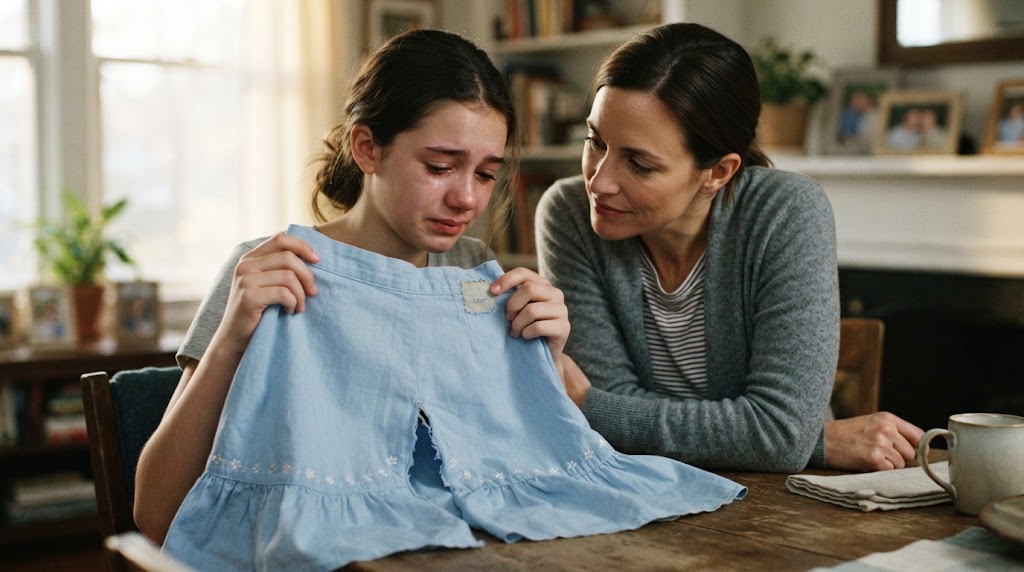
Back in the office, Mrs. Wilson knelt beside Emily and asked for a few minutes alone. Emily gripped the fabric across her knees and finally explained. The skirt had belonged to her grandmother.
Evelyn, Mrs. Wilson’s mother, had died two years earlier. She and Emily had been close. They baked, planted flowers, and spent rainy afternoons turning leftover fabric into small treasures.
After the funeral, Mrs. Wilson had packed her mother’s clothes into a cedar chest in the attic. She couldn’t face sorting through them. A month before the presentation, Emily had quietly gone up there and found the grandmother’s skirt.
She kept it in her closet. It had a few holes, so she fixed them herself, using the small stitches Evelyn had taught her years ago and a few sewing videos to refresh her memory. The repairs weren’t perfect, but they were careful and neat.
Evelyn had worked as a seamstress when she was young. She used to say that clothes could tell stories, and Emily wanted the grandmother’s skirt to tell one in front of her class.
The Grief Nobody Was Talking About
Mrs. Wilson asked why Emily hadn’t come to her for help. The answer stung. Emily said her mom always got sad when they talked about Grandma, and always changed the subject.
It was true. For two years, Mrs. Wilson had steered conversations away from her mother, believing she was sparing her daughter from her own grief. Instead, she had left Emily to remember her grandmother alone.
She apologized. Emily told her it was okay, then admitted something heartbreaking: she had hoped that restoring the grandmother’s skirt and wearing it would make her mother happy.
Then she shifted in the chair and revealed the damage to the grandmother’s skirt. A long tear ran down the back seam, and a section of fabric had pulled loose. It was worse than Mrs. Wilson had imagined, and it explained everything.
Getting Emily Home With Dignity
Principal Harris brought in loose athletic pants and a sweatshirt. Mrs. Wilson helped Emily into a nearby restroom, keeping the skirt wrapped around her until she could change in private.
Emily came out holding the grandmother’s skirt against her chest. She didn’t want to leave it behind, and she didn’t have to.
The principal apologized for not helping her feel comfortable sooner. He said the school would speak with Tyler and the students who laughed, since mocking someone’s clothes was not acceptable. Emily asked that her classmates not be made to talk about her, and he promised there would be no announcement.
As they packed up, Mr. Bennett came to the doorway and asked if he could say something. Mrs. Wilson reminded Emily that she could say no. She chose to listen.
He apologized for telling her to stop making a scene and said he should have asked what was wrong. Emily told him she hadn’t been trying to make a scene, and pointed out that Tyler laughed before the skirt ever tore. He agreed he should have addressed that right away and told her she could finish the assignment another way, whenever she was ready.
A Hidden Message Stitched Inside
On the drive home, Emily held the grandmother’s skirt in her lap. Her mom asked what she had planned to tell the class.
Emily said Evelyn had made the skirt when she was young and wore it the day she met Grandpa. He was so nervous he spilled lemonade on himself. For the first time that day, they both laughed a little.
Then Emily turned the skirt inside out. Near the waistband was a small embroidered patch with faded letters: “For Emily, who makes every ordinary day beautiful.”
Mrs. Wilson remembered the day her mother sewed it. Emily was eight, learning to make fabric flowers. Evelyn had found the skirt while cleaning a closet and said she was saving it for her granddaughter.
Emily had thought she found it by chance. Her mom told her that maybe she had, but that the grandmother’s skirt had always been meant for her. Emily worried that she had ruined something saved just for her. Her mother touched the embroidery and reminded her that the message itself was still whole.
Repairing the Grandmother’s Skirt, Stitch by Stitch
That evening, they laid the grandmother’s skirt across the dining table. The tear cut through the back seam and some of the surrounding cloth, but the embroidered flowers were mostly untouched.
Mrs. Wilson wasn’t sure she could make the grandmother’s skirt look the same. But she knew someone who might. June, Evelyn’s closest friend, had sewn alongside her for years, working on wedding dresses, school costumes, and more curtains than anyone could count. Mrs. Wilson hadn’t called her in months.
When she did, June simply told her to bring it over. That afternoon, she studied the grandmother’s skirt under a bright lamp, turned it inside out, and gently touched the embroidery.
Emily apologized to her for ruining it. June asked why she was apologizing at all. She explained that Evelyn made clothes to be worn, and would have loved seeing her granddaughter in something she cherished. Fabric, she said, sometimes tears.
June said she could repair the seam and reinforce the weak spots, though the fix might show a little. She had one condition: Emily had to help. She pointed to the girl’s earlier stitches and said her grandmother had taught her well.
For the next hour, June showed Emily how to strengthen the torn area of the grandmother’s skirt without pulling the fabric too tight. At one point, she laughed and shared that Evelyn once sewed a whole sleeve on backward. Emily was amazed that her grandmother made mistakes. June said she made plenty, and simply knew how to fix most of them.
Watching them, Mrs. Wilson noticed that talking about her mother no longer felt unbearable. It felt like Evelyn was in the room with them.
Returning to Class on Her Own Terms
Over the next week, Emily and June worked on the grandmother’s skirt two more times. Meanwhile, Mrs. Wilson met with Principal Harris and Mr. Bennett.
The damaged chair had been removed and the other chairs inspected. Tyler had been spoken to, and his parents had been contacted. Mr. Bennett had apologized to the class for mishandling an incident, without naming Emily or describing what happened to her.
He also wanted Emily to keep full credit for her assignment. Mrs. Wilson agreed, as long as Emily decided how to present. Her options were a written report, a private presentation, or speaking to the class on another day.
Emily asked if she could show the grandmother’s skirt once it was fixed. She believed her grandmother would have wanted people to know about it.
The following Friday, she returned to history class in ordinary jeans, carrying the repaired skirt in a cloth bag. Mr. Bennett let her present at the start of the lesson. She held it up and talked about her grandmother’s life as a seamstress, how she supported her family, and how she taught Emily her very first stitches.
Then she showed the mended seam. She told the class she had thought the skirt’s story ended when it tore, but that her grandmother’s friend helped her repair it, and now it had a new chapter.
Classmates asked about the embroidery. One girl wanted to know how long the repairs took. Emily answered every question.
After class, Tyler apologized for laughing. Emily told him he had embarrassed her and that she didn’t want any more jokes about her clothes. They didn’t become friends, but she was proud she had spoken up for herself.
What This Family Learned About Grief
That night, Emily smoothed the grandmother’s skirt across her bed and asked whether her grandmother would be proud. Her mom said yes, proud of her hard work and proud that she told Evelyn’s story. Being hurt, she added, didn’t mean Emily had done anything wrong.
Emily asked if they could talk about Grandma more, even if it made them sad. Her mother took her hand and said that was exactly when they should.
They spent the evening going through photos that had been hidden in the cedar chest for two years. Emily laughed at her grandmother’s huge glasses and asked about her childhood. Some stories made them laugh. Others made them cry. This time, nobody changed the subject.
Families facing a loss like this don’t have to figure it out alone. The Dougy Center offers free resources to help children and teens grieve, and you can find more stories about family, healing, and hard transitions at Divorce Matters Today.
A few days later, Emily hung the grandmother’s skirt in her closet. The seam was still visible where old fabric met new thread, but she didn’t mind, because it reminded her of the afternoons spent sewing with June. At the bottom of her history report, she added one line of her own: the most important things we inherit aren’t always the ones that stay perfect. Her mother finally understood that what Emily needed most was never a flawless repair, but the promise that she would never have to carry her grief alone again.