Late Husband’s Letter Reveals Heartbreaking 40-Year Secret
Some truths arrive too late to change the past but just in time to change the future. For Loretta, a 60-year-old retired teacher, that truth came folded inside her late husband’s letter, handed to her by a lawyer only days after Henry’s sudden death.
What made it harder was the timing. The last real conversation she’d had with Henry was the moment she told him she wanted a divorce.
A Marriage That Looked Perfect From the Outside
Loretta married Henry when she was 20. Forty years later, they had a lovely home, three grown children named Rachel, Michael, and Emma, and five grandchildren.
Henry worked as an accountant, and Loretta taught elementary school. They were steady, responsible people who paid every bill on time and gave their kids a stable life.
Yet once the children moved out, the house grew quiet in a way that didn’t feel peaceful. Henry retreated to his study each evening, and Loretta settled into the living room with a book or the television.
Some nights, they spoke fewer than 10 sentences to each other. She came to feel lonelier sitting next to her husband than she did by herself.
The Small Moments That Slowly Built a Wall
Loretta had always longed to travel. She dreamed of Italy and Africa, or even just a weekend somewhere she didn’t have to cook dinner.
Henry’s answer rarely changed. To him, a trip was money that might be needed for something more practical.
Once, she suggested a stay at a lakeside hotel. Henry glanced at the price and pointed out it could pay for a new washing machine instead, and that’s exactly what they bought.
Eventually, she gave up asking. But the little moments hurt even more than the canceled plans.
When she showed him a new dress, he’d barely look up from his desk before calling it fine. On their 38th anniversary, he brought her lilies, even though she’d loved peonies since childhood and lilies set off her allergies.
Through tears, she asked whether he really knew her at all. Henry laughed it off and said they were only flowers, as if she had to be joking.
She wasn’t. Not long after, she watched him spend 45 minutes carefully repairing an old desk lamp, more time than he’d spent talking with her in months, and she knew something had to change.
Divorce Papers Before the 40th Anniversary
Shortly before their 40th wedding anniversary, Loretta filed for divorce. When she handed Henry the papers, the color drained from his face.
She told him he had never understood her and maybe had never truly known her. Henry didn’t argue or plead with her to stay. He simply said, quietly, that he saw.
That silence stung more than any fight could have. Loretta packed a suitcase and moved into Rachel’s guest room.
Henry called the next afternoon, but she let it ring. She assumed they’d talk once things cooled down.
They never got the chance. A week later, Henry died of a sudden heart attack, and Loretta kept telling Rachel that they hadn’t finished talking.
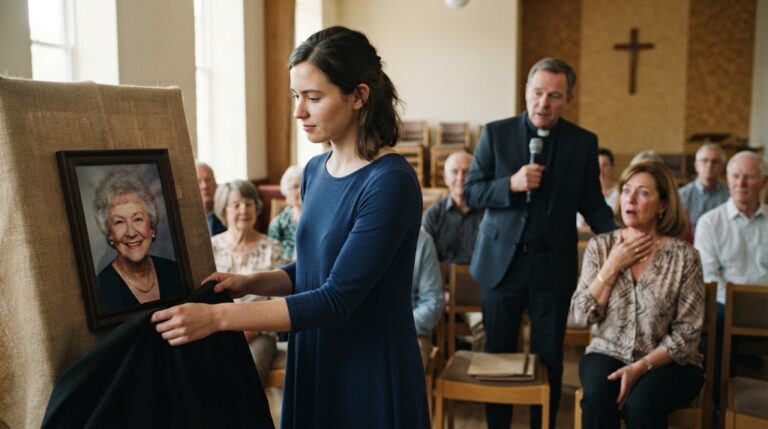
At the funeral, people described Henry as reliable and devoted. They were right, but none of them knew how lonely she had been, or what her late husband’s letter would soon reveal.
What Her Late Husband’s Letter Revealed
A few days later, the family lawyer, Mr. Collins, asked Loretta to come to his office. He explained that Henry had visited him two days after receiving the divorce papers to make sure his wife received something if anything happened to him.
The sealed envelope held several handwritten pages and a small brass key. Opening her late husband’s letter, Loretta saw he had addressed her as his dearest wife, words she hadn’t heard from him in years.
He described their wedding day in vivid detail, from her mother’s tears to her crooked veil to his own nerves. He even remembered that she had wanted to honeymoon in Italy.
Then came a confession. Henry admitted he had always blamed money for refusing to travel because he was ashamed of the real reason.
The letter told her to use the key on a locked drawer in his study. Despite her grief, Loretta nearly smiled, since even now Henry couldn’t explain anything without paperwork.
A Locked Drawer Full of Forgotten Dreams
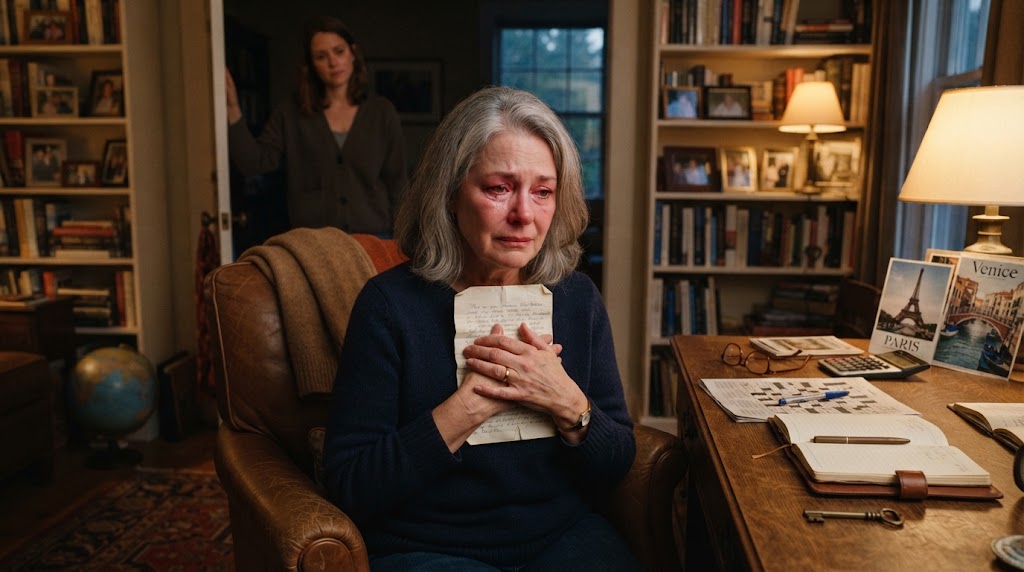
Back at the house, the study looked untouched. His glasses rested beside his calculator, his favorite sweater hung on the chair, and a half-finished crossword waited on the desk.
The key opened a drawer beneath the filing cabinet. Inside sat a folder labeled with her name.
It held photos, magazine clippings, and several notebooks. The clippings showed Paris, Africa, and Venice, all places she had once said she wanted to see.
The oldest notebook dated back almost 20 years. Henry had written down her wish to spend a whole day looking at paintings in Paris and her hope to visit Africa someday.
A newer entry was harder to read. He had noticed she no longer brought up travel, and he feared it was because she already knew what he would say.
Guided by her late husband’s letter, Loretta began to see that Henry had been listening all along. She called Rachel, who said her father had asked last spring whether Loretta’s passport was still valid and hinted he was planning something for their anniversary.
Rachel had never heard of the notebooks. Henry had kept them hidden from everyone.
The Childhood Fear Behind Every Saved Dollar
The next pages explained what Henry had never said out loud. He had grown up poor, and when he was 12, his father lost his job.
For months, the family stayed with relatives because they couldn’t afford rent. His mother counted coins before buying groceries, and Henry wore shoes with holes while pretending his feet weren’t cold.
In her late husband’s letter, he explained that every dollar he saved felt like protection for his family. When Loretta pictured hotels and adventure, he pictured emergencies that might drain their savings.
He had spent decades bracing for a disaster that never came. Meanwhile, she had spent those same years waiting for him to enjoy the life they’d built.
Her late husband’s letter also explained how they had drifted into separate rooms. Work wore him out, he craved quiet in the evenings, and he assumed she wanted the same.
He wrote that he thought she enjoyed being alone. He hadn’t realized she stopped visiting his study because he so rarely looked up when she walked in.
The Truth About the Dress and the Lilies
The dress was painful to revisit. Henry remembered the blue dress she wore to Emma’s wedding, right down to the way she had pinned up her hair.
He had thought she looked beautiful. But a work problem had distracted him, so he said it was fine and assumed she knew how he felt.
Loretta had nearly returned that dress. Reading her late husband’s letter, she finally understood his flat reaction had nothing to do with her.
He also owned up to the lilies. He had once known how much she loved peonies, but over time he stopped paying attention and simply bought what the florist recommended.
When she asked whether he knew her, he thought she was teasing him about a poor choice. Now he understood she had really been asking whether he still cared enough to remember.
That was exactly the question she had been asking. Her late husband’s letter finally answered it.
A Hidden Travel Plan and a Secret Savings Account
One last note sent her back to the drawer. Beneath the notebooks lay a folder and a bank statement.
The folder held a handwritten itinerary for four weeks in Florence, Rome, Africa, and Paris. Henry had listed hotels, museums, train routes, and restaurants.
Next to Paris, he noted that Loretta had to see the paintings. Next to Africa, he wrote that she deserved breakfast with a view of Table Mountain in Cape Town instead of their own kitchen.
The bank statement showed a separate savings account he had opened years earlier. Some months he added $50, some months $100, and in tight months nothing at all.
Still, he kept going. Every small deposit quietly backed up the promise in her late husband’s letter, and the balance was enough to cover the entire journey.
Looking at his empty chair, Loretta whispered, asking why he had never told her. The answer was waiting on the final page.
The Final Words in Her Late Husband’s Letter
Henry had planned to surprise her on their 40th anniversary. He imagined handing her the itinerary and watching her face as she realized they were finally going.
He believed one wonderful trip could make up for years of saying no. Then the divorce papers arrived, and he finally understood the real problem.
She wasn’t leaving because they had never gone to Paris. She was leaving because he had made her feel like her happiness was an inconvenience.
He wrote that he had mistaken providing for her as being enough. The dresses, the weekend ideas, the complaint about the flowers had all been her way of asking for his attention.
He confessed that he had kept saving for their future while letting their present slip away. He thought he had plenty of time to set things right.
Henry said he would not stand in her way if she still wanted the divorce. But he loved her, even if he hadn’t known how to give her the kind of love she needed.
His closing wish was simple. If she would let him, he wanted to try again, and if she couldn’t, he wanted her to take the trip anyway, buy the dresses, order dessert without checking the price, and stop waiting for permission to enjoy her life.
Loretta sat in his chair, holding her late husband’s letter against her chest, and cried until there was nothing left.
Grief, Anger, and Love Can All Be True
Rachel found her there that evening and read through everything in silence. Then she hugged her mother and asked whether she would take the trip.
Loretta wasn’t sure she could go without him. Rachel gently told her that this was exactly the reason to go.
Her late husband’s letter didn’t erase years of missed conversations or prove she had been wrong to feel lonely. Knowing he loved her didn’t change how often she’d wished he had shown it.
But it changed how she saw him. Henry hadn’t been indifferent. He had been afraid of losing money, afraid of failing his family, and afraid to admit he had forgotten how to be close to her.
She wished they had talked honestly before it was too late. All she could do now was decide what came next.
A Blue Dress Beside a Venice Canal
Three months later, Loretta stood beside a canal in Venice in a blue dress she had bought for the trip. Henry’s photo was tucked inside her purse.
That morning, she had gotten lost looking for a café. A recently widowed 63-year-old woman named Mylah, also traveling alone, helped her find it, and the two ended up sharing breakfast.
When Loretta mentioned it was her first time in Europe, Mylah laughed and told her she had some catching up to do. For the first time in months, laughing didn’t hurt.
Later, she took out Henry’s photo and quietly told him she had made it. She loved him, she was angry with him, and she missed him, and every one of those feelings was real.
Then her phone buzzed. Rachel had sent a picture of Loretta’s youngest grandson holding a drawing of Grandma beside the Eiffel Tower, with a note cheering her on.
Lessons From a Late Husband’s Letter
Loretta’s story is a reminder that love and attention aren’t the same thing. Henry worked for decades to keep his family safe, but safety alone couldn’t make his wife feel seen.
Many long marriages drift apart in exactly this quiet way. Nobody is cruel, yet small moments of neglect pile up until one partner feels invisible.
A late husband’s letter can’t replace the conversations a couple never had. Still, Henry’s words show how much can shift when someone finally explains what they were too afraid to say.
If you’re facing a similar crossroads, an honest conversation is worth trying while there is still time. You can find more real stories about separation, reconciliation, and second chances at Divorce Matters Today.
For anyone grieving the loss of a spouse, the National Institute on Aging offers practical guidance on coping with loss and rebuilding daily life afterward.
In the end, her late husband’s letter gave Loretta more than answers. It gave her permission to stop waiting and start living the adventurous life Henry finally wanted for her.