
Porcelain Frogs: 33 Garage Sale Finds, 1 Incredible Secret
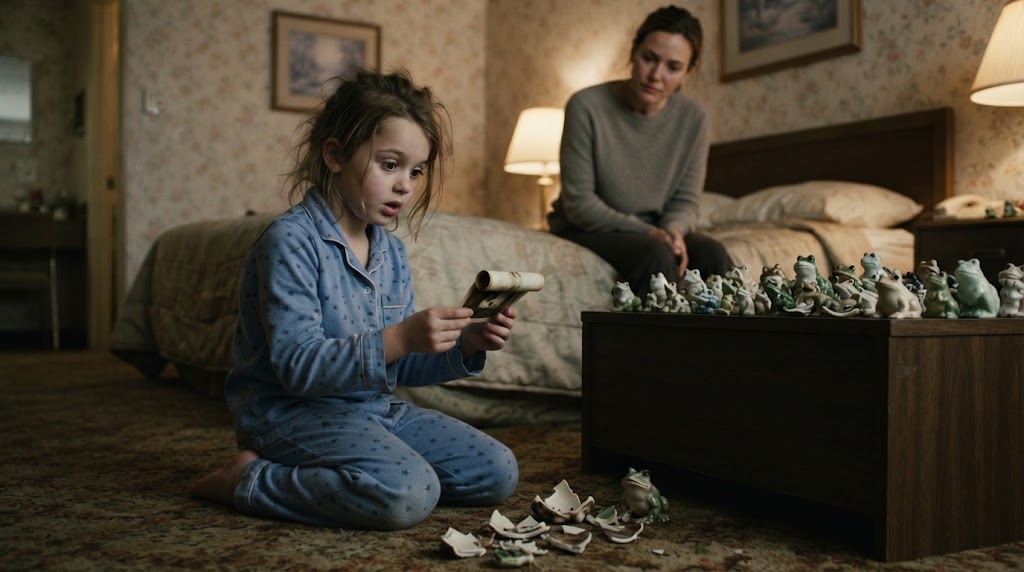
The sound was small, just a crack against a motel room floor. One of the 33 porcelain frogs a mother had bought that week with her last $10 lay in pieces, and her daughter, who had turned 8 that very day, was holding something that had been hidden inside it.
It was a rolled-up school photo. The girl in the picture had uneven bangs and a missing tooth, and she was the mother herself at 8 years old.
On the back, someone had written five words telling her to break the biggest frog first. Nothing about the past three months had made much sense. This made the least sense of all.
How a Family Ended Up in a Highway Motel
Three months earlier, her husband, Daniel, had left her for his secretary. He did not leave quietly. He took most of the money from their joint account, changed the locks on the house, and had his lawyer explain that she could schedule a supervised visit to pick up her personal necessities.
That list turned out to be short. The couch she had paid for stayed behind. So did the dining set, her grandmother’s dresser, and about half of her own clothes.
While the attorneys traded letters, she and her daughter, Amy, moved into a motel room next to the highway. It had one bed, one chair, and a bathroom fan loud enough to pass for a lawn mower.
One night Amy watched her mother scrub a school uniform in the sink and asked whether they were poor now. Her mom said they were just being careful with money. Amy thought it over and asked the question that mattered most to her: would there still be cereal in the morning?
There would. But on some nights her mother claimed she had already eaten, because one dinner goes further when only one person eats it. Amy never complained, and that quiet acceptance hurt more than any tantrum could have.
Why She Spent Her Last $10 on Porcelain Frogs
With the birthday one day away, she wanted Amy to have a single gift from her, something wrapped that a child could tear open. She had $11 and a few coins in her wallet.
On the drive to school pickup, she passed a garage sale sign taped to a telephone pole. She nearly kept going. Then she saw a folding table crowded with little animal figurines, and most of them were porcelain frogs.
Amy had adored “The Frog Prince” since preschool. She liked to joke that if she kissed enough frogs, one would eventually have to become a prince. The table held 33 porcelain frogs in all, some in crowns, some holding flowers, one under a tiny umbrella, and one dressed as a chef.
A cardboard sign offered the whole set for $10. It was not a sensible purchase for a woman counting coins. She bought them anyway.
A Stranger Who Asked About Pine Street
The seller was a woman of about seventy with silver hair, gardening gloves, and a kind face. She noticed her customer’s red eyes and gently asked if she was all right.
That was enough. The whole story came out: the husband, the locks, the motel. The older woman listened without interrupting and then said Amy was a lucky little girl. When the mother pointed out that her child lived in a motel, the woman replied that she had not been talking about circumstances.
Already late for pickup, the mother asked if the porcelain frogs could be boxed up and held until morning. The woman agreed, pulled off a glove, and introduced herself as Martha.
When she heard her customer’s name, Martha’s grip tightened. She asked whether she had grown up nearby, maybe around Pine Street. The answer was yes. Martha studied her for a moment, smiled, and said she was only curious.
The next morning a sealed cardboard box of porcelain frogs was waiting. Martha held her hand a little longer than expected, as though she had more to say, and then let go.
The Night the Porcelain Frogs Broke Open
That evening Amy sat cross-legged on the motel bed, surprised to get a present before the weekend with her dad. She peeled back the tape, saw the first frog, and gasped. Then she kept going.
Soon the porcelain frogs covered the little table in what she called a whole frog kingdom. She handed out titles as she went: a princess, a knight, a doctor, and one she named Suspicious Frog because of the look in his eyes. Her mother had to admit the name fit.
Among the porcelain frogs was a small one holding a blue flower, and its base rocked when Amy set it down. She reached to move it somewhere safer, caught it for an instant, and lost it.
Amy apologized right away. Her mother told her it was only porcelain. Then Amy went still, because a photograph was lying among the pieces.
They agreed the message on the back was creepy. They also agreed, without much debate, to follow it. The biggest of the porcelain frogs was bright green, nearly a foot tall, and wore a golden crown.
The mother wrapped it in a motel towel, sent Amy to the far end of the bed, and struck it against the floor. It split on the third try.
Three things fell onto the carpet: an old brass key, a laminated card with a hand-drawn map, and another photograph. This one showed her as a little girl, sitting next to her father outside a wooden cabin.
Her father had died when she was still a child. Yet his handwriting was on the back, a note saying this was for whenever she needed somewhere to begin again. Under it, in newer ink, a second hand had added an instruction to follow the map.
A Cabin by the Lake and a Deed in Her Name
She knew the sensible move was to phone her lawyer. Instead, the next morning, she buckled Amy into the car and drove.
Almost an hour later the map delivered them to a small wooden cabin near a lake. The porch sagged a bit and the windows needed washing, but the building was standing. The brass key turned in the lock.
Inside were dusty chairs, a wood stove, fishing rods, blankets, and framed pictures. Every one of them was of her: holding up a fish, grinning without her front teeth, asleep on her father’s shoulder.
What unsettled her was that her father had never once mentioned owning a cabin. Days earlier she had thought she was buying porcelain frogs as a cheap birthday gift, and now she was standing in a house full of her own childhood.
In a desk drawer, under a stack of old maps, she found a folder with tax receipts, insurance papers, and a deed. She read the deed three times. It had been recorded in her name when she was 8.
From the porch she called the county records office. A clerk confirmed the deed was still hers and that the property taxes were current. When she asked about the mailing address on the tax account, the clerk read out a name she had only just learned. Martha.
Who Martha Really Was
Martha opened her front door before the knock came. She already knew the cabin had been found. Asked who she was, she answered with wet eyes that she was the father’s cousin.
She explained that he had always planned to tell his daughter about the cabin once she was older. He ran out of time. While he was alive, he gave Martha a spare key and a box of papers and photographs, with instructions to pass them along if he never got the chance.
After his death the family moved away fast. The address Martha had stopped working. She tried relatives and old phone numbers and came up empty, so she did the one thing she still could. She kept paying the taxes so the place would be protected.
The porcelain frogs had a history too. Her cousin had bought them one at a time for a daughter who was obsessed with a certain fairy tale, and he kept them at the cabin. Years later, when the roof needed work, Martha took them home.
She had only been clearing out her house when a tired woman with her cousin’s eyes walked into the yard. The name, and then Pine Street, settled it.
The treasure hunt was Martha’s idea, not his. One of the smaller porcelain frogs had an old repair on its base and already wobbled, so she tucked the school picture inside and resealed it loosely. She wrote the newer line on the cabin photo herself.
She admitted she almost just said it out loud. But a father had left all of this for an 8-year-old girl, and that girl had returned with an 8-year-old of her own and nowhere left to go. It felt right to let the porcelain frogs lead her back.
What the Cabin Changed in Court
On the drive home she finally called her attorney, expecting to hear that a surprise property would complicate everything. The lawyer went quiet instead, then asked her to repeat it. The deed was in her name alone, and Daniel’s name appeared nowhere on it.
The lawyer wanted a copy that night. That same morning, Daniel’s attorney had filed papers asking that Amy spend most school nights with her father until her mother had stable housing.
The man who emptied the account and changed the locks was now pointing to the motel as proof she was unstable. In the back seat, Amy slept against the window clutching Suspicious Frog, one of the porcelain frogs that had started all of this.
At the temporary hearing, Daniel’s side argued the cabin was old, remote, and unsuitable. Her lawyer answered with the deed, receipts showing the utilities worked, and bank records showing how much had left the joint account days before the locks were changed.
The judge looked at Daniel, then at his lawyer. Amy stayed with her mother on school nights. Daniel had to put part of the money back, and a date was finally set for her to collect her belongings, the dresser and the rest of her clothes included.
She did not describe the feeling as triumph. It was closer to relief. For the first time in months, she no longer felt trapped.
Starting Over, Cracks and All
They moved into the cabin. It needed a great deal of work. Martha showed up with cleaning supplies, the floors got scrubbed until hands ached, and Amy picked a pale green for her small bedroom, which she naturally called frog green.
On their first Saturday there, rain tapped the windows while Amy ate cereal from a chipped blue bowl. She caught her mother staring and reported, between spoonfuls, that they still had cereal. Her mom had to turn away to laugh.
The legal fight went on, but the footing was different. She was no longer negotiating while terrified of becoming homeless. She had a roof, a deed, and a door that no one else could lock.
Over the following months they fixed the porch, replaced two windows, and stuck glow-in-the-dark stars across Amy’s ceiling. The 31 unbroken porcelain frogs went on a shelf above the fireplace.
The crowned one sits with them, glued back together, thin cracks still running through the gold. When her mother offered to replace it because it was broken, Amy was horrified. She climbed on a chair, touched the crown, and explained that he still gets to be the king.
What This Story Says About Hard Seasons
A story about porcelain frogs and a hidden key lands because the fear underneath it is so ordinary. A separation can drain a bank account, cost someone their home, and turn housing into an argument over where a child sleeps.
Not everyone has a cabin waiting at the end of a hand-drawn map. Many people do have options they have not found yet. If you are facing a divorce with very little money, the nonprofit LawHelp.org can point you toward free and low-cost legal aid in your state.
For more guidance and stories about separation, custody, and rebuilding, visit Divorce Matters Today.
A father bought his daughter a few fairy-tale figurines and quietly put a home in her name. Years later, a cousin who never stopped looking made sure both reached her. Thirty-three porcelain frogs cost $10 at a garage sale, and they carried a family home.