Unsent Letters Revealed a Heartbreaking Truth After 1 Year
Some people leave behind jewelry or a little money when they pass away. My neighbor Margaret left me a wooden box of unsent letters and the hardest decision I’ve ever been trusted with. I thought it would be a sweet goodbye gift. Instead, it turned everything I believed about her upside down.
A Rainy Afternoon and a Split Grocery Bag
I was 47 that year, newly divorced and still learning how quiet a house can be when only one person lives in it. One afternoon, driving home in heavy rain, I spotted an older woman walking with her arms full of groceries.
I pulled over and offered her a ride. She told me, very politely, that she could get home just fine on her own.
Right then, one of her bags tore open. Apples bounced along the sidewalk, and a can of beans rolled under a parked car.
I jumped out and helped her chase down her groceries. When I teased her about being so capable, she called me bossy. I told her my name was Josette, and she finally laughed.
Her name was Margaret. She lived just three houses down from me, and I had never once spoken to her. I thought I was rescuing a lonely neighbor that day. I had no idea that a box of unsent letters was sitting in her attic.
How Saturdays Turned Into Something Like Family
A few days later, I knocked on her door to ask if she needed anything from the store. She handed me a shopping list before I’d finished my sentence and admitted she’d hoped I would come.
That small exchange became our rhythm. On Wednesdays I picked up her list, and most Saturdays I stayed for tea.
Tea slowly grew into lunch, crossword puzzles, and friendly fights over TV. Margaret loved mystery shows and always insisted she’d spotted the liar first, even when we both knew she’d seen the episode before.
One Saturday, she pulled out a basket of yarn and announced she was teaching me to knit socks. Her reasoning was simple: everyone should know how to make at least one useful thing.
My first sock looked nothing like a sock. Margaret laughed so hard she had to set her needles down. Then she told me not to worry, because “Jo” would get there.
Nobody had ever called me Jo before. Coming from her, it felt like a name I’d always had. A year later, that same nickname would be written across a box of unsent letters.
The Phone Calls She Never Answered
After my divorce, I’d felt invisible for a long time. Margaret saw me without my having to ask. If I looked worn out, tea appeared. If I brought cookies, she made sure I ate some too.
But there was one subject she always slid away from: her family.
Once, while she was showing me how to fix a dropped stitch, her phone rang. She checked the screen, let it ring out, and went straight back to knitting as if nothing had happened.
Another day, I noticed a photo near her bookshelf. A younger Margaret stood beside a smiling woman and a little girl. She told me it was her sister and her sister’s daughter, Trina.
When I asked whether she saw Trina often, Margaret said “not anymore” and quickly asked if my sock would be finished before Christmas.
Months later, I found her sitting by the telephone with red eyes. She said families were complicated and that some people leave without you ever understanding why. I wanted to ask about Trina, but I made sandwiches instead and stayed until she smiled again. I didn’t know yet that her unsent letters held the answers I was too polite to ask for.
A Phone Call, a Funeral, and a Strange Remark
About a year after that rainy afternoon, my phone rang early one morning. The caller introduced herself as Trina, Margaret’s niece. Margaret had passed away in her sleep.
Trina said her aunt had mentioned me often, and she’d found my number in Margaret’s phonebook. Through my window, I could see Margaret’s curtains were still closed.
I cried at the funeral harder than I expected to. Trina stood near the front greeting guests. She looked exhausted, and I wondered how long she’d been handling everything alone.
Afterward, I thanked her and told her Margaret and I had spent nearly every Saturday together, and that she’d tried to teach me to knit. Trina smiled faintly and said her aunt used to knit all winter.
Then she said something that stayed with me. She was glad somebody had gotten to know “that side” of Margaret. When I asked what she meant, she brushed it off and excused herself. It would take a box of unsent letters to show me what she meant.
The Box in the Attic and the Unsent Letters Inside
Three days later, Margaret’s lawyer, Mr. Benson, called. Margaret had left instructions for him to contact me after her passing.
At his office, he handed me a sealed envelope. Inside, in Margaret’s shaky handwriting, was a short note. There was a box in her attic with my name on it, and what was inside had never been meant for anyone else.
Mr. Benson didn’t know what the box held. He explained that Trina was handling the house, so I’d need to arrange a visit with her. When I called, Trina said Margaret had never mentioned any box, but she told me to come the next morning.
Walking into that house felt strange. Margaret’s knitting basket still sat beside her favorite chair, and part of me expected to hear her call out from the kitchen.
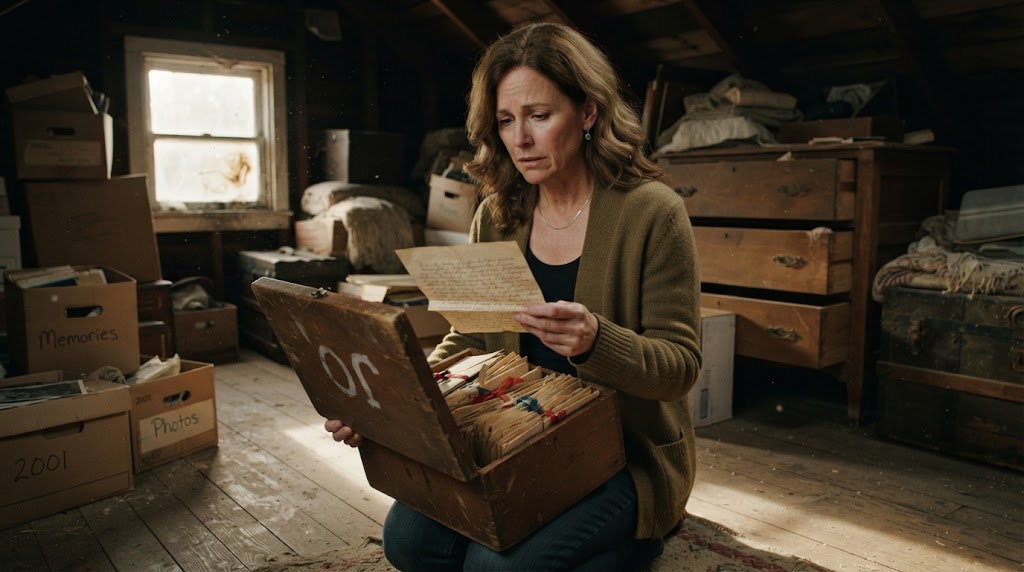
Up in the attic, near an old dresser, I found a wooden box with JO written across the lid. Inside were bundles of unsent letters tied with ribbon, plus a separate envelope on top.
That envelope was addressed to me. Margaret wrote that I’d always asked whether she needed anything, and there had been something she needed but could never bring herself to ask.
The letters were for Trina. She had written them over many years but was too afraid to mail them. She trusted me to decide whether Trina should ever have them, and she told me not to feel obligated.
I opened the oldest of the unsent letters. In it, Margaret apologized for what she’d said about Trina’s mother. She admitted Trina had every right to take that job, and that fear of losing her had made Margaret pile on the guilt.
Another letter, written two years later, said simply that she missed Trina and wished they could start again. I sat on the attic floor surrounded by unsent letters and wondered why she had never mailed even one.
Then I remembered a Saturday when I’d asked about Trina. Margaret told me she’d said something awful about Trina’s mother. When I asked if she’d apologized, she only said she’d thought about it.
When I Judged the Wrong Person
Downstairs, Trina was wrapping dishes. I told her the box held letters, all addressed to her, written over many years.
She seemed surprised, then guarded. When she learned I’d read some of the unsent letters, she said maybe her aunt should have mailed them.
I should have stopped there. Instead, I told her Margaret had missed her and had been lonely. Trina reminded me that I’d only seen the last year of her aunt’s life.
Then I asked the question I still regret: where had she been?
Trina went very still. She asked if I truly didn’t know what had happened, said I’d already made up my mind, and asked me to leave and take the box with me.
At home, I tried to convince myself that a year of Saturdays meant I knew Margaret better than her own niece. But another memory crept back. Once I’d suggested she call Trina, or at least send a birthday card. Margaret’s voice turned sharp, and she told me to leave it alone.
I went back through the unsent letters that night, and one line stopped me cold. Margaret wrote that she knew Trina had tried to see her the previous spring.
Another letter said she’d wanted Trina to come home but couldn’t bear to hear her say she wouldn’t. Margaret hadn’t only been waiting. She’d been afraid.
I called Trina, but she didn’t pick up. So I texted an apology, admitting I’d been unfair and should have heard her side before accusing her. No reply came.
The Other Half of the Story
Two days later, I baked Margaret’s favorite cookies and started packing some into a container. Then I stopped. For years, I’d brought people food whenever I didn’t know how to have an honest conversation. Cookies weren’t going to fix this, and neither were Margaret’s unsent letters.
I called Trina again, and this time she answered. I told her I wanted to talk about how I’d treated her. After a long silence, she said she’d be at the house for another hour.
I found her sitting among boxes of photographs. I told her I’d accused her of abandoning someone without knowing enough to judge, and that I’d come to listen.
She opened a box of her own. It held birthday cards, envelopes, and printed messages. In a way, they were the mirror image of Margaret’s unsent letters, because these had been sent and pushed away.
One card, mailed five years earlier, had come back to her unopened. There were two more returned envelopes, and a message she’d sent while visiting town, asking her aunt to lunch. Margaret’s reply was that there was no need.
Trina explained that Margaret had practically raised her after her mother died. When she got a job in another state, she expected her aunt to be proud. Instead, Margaret said she was abandoning her, and then said her mother would have been ashamed of her.
The next weekend, Trina came back to apologize for shouting. Margaret wouldn’t let her in. Years later, on another visit, the door stayed closed again. Trina showed me a photo her husband had taken of her standing outside that same front door.
She’d called every Sunday for months. Once, Margaret called on Trina’s birthday, and Trina hoped they might finally talk. But Margaret only asked whether she’d quit her job and moved back. When Trina said no, Margaret hung up.
Trina said she had loved her aunt, but she couldn’t keep proving it by letting Margaret punish her. Looking at those returned envelopes, I finally understood. Both women had been telling me the truth.
Why the Unsent Letters Still Mattered
I had brought the box with me. When Trina asked why her aunt never sent the letters, I told her honestly that I didn’t know. All I had was Margaret’s word that she’d been afraid.
Trina gave a sad smile and said her aunt had always hated admitting she was wrong.
I told her the unsent letters included an apology about her mother and memories of her graduation. There was even a photograph tucked inside one of them.
Trina asked whether I was hoping she’d forgive her aunt. I told her no. The unsent letters belonged to her, and what she did with them was her decision.
She read the oldest of the unsent letters slowly, then another. At the third, she stopped. Inside was her graduation picture, the one she had sent in that returned birthday card. Margaret had taken the photo out before mailing the card back.
Trina had always assumed her aunt threw everything away. She said Margaret could have apologized while she was still alive. I agreed that she should have. Trina thanked me for bringing the letters, and I helped her pack the rest of the photographs.
What Margaret Left Behind for Both of Us
Four days later, there was a knock at my door. Trina stood outside holding Margaret’s knitting basket, which she’d found while clearing out the living room.
She told me her aunt had once tried to teach her to knit, and she’d been terrible at it. I admitted I was too. Then she asked if I could show her.
I pulled two chairs up to the table, handed her a pair of needles, and repeated the words Margaret had once said to me: everyone should know how to make at least one useful thing.
Lessons From a Box of Unsent Letters
Looking back, I’m grateful Margaret trusted me with those unsent letters, even though she chose the hardest possible way to say she was sorry.
She was truly kind to me. She was also deeply hurtful to the person she loved most. Both things were real, and I only saw one of them because I knew her for a single year.
I learned something about myself too. I’d spent so long holding my marriage together that I rushed to defend the person I cared about instead of listening to the person who was hurting. Real kindness sometimes means asking questions before taking sides.
Unsent letters are really conversations someone was too scared to start. Margaret’s fear cost her years with the niece she had raised, and no box in an attic could give those years back.
If an older relative or neighbor in your life seems isolated, the National Institute on Aging shares practical tips for staying connected and easing loneliness. And if you’re rebuilding after the end of a marriage and learning to trust your own judgment again, you’ll find honest stories and support at Divorce Matters Today.
Margaret’s apology arrived years too late, and it came through a near stranger’s hands. Still, those unsent letters gave Trina something she never expected: proof that her aunt had kept loving her, even behind a closed door.