
Wheelchair Dance After 18 Months: An Unforgettable Comeback
Eighteen months after a car crash took both of Chloe’s legs, she rolled onto a school gym floor for her first wheelchair dance. Her mother, Rachel, was filming every second. Then the music cut out, and a stranger pushed her daughter straight out of her chair.
For a moment, Rachel thought her child was being attacked. She was wrong. What really happened that afternoon changed how she understood fear, protection, and what it means to keep living after a loss.
The Day Everything Changed
The crash happened on an ordinary Tuesday afternoon. A driver ran a red light and hit the passenger side of their car. Rachel still remembers the sound more than anything else: metal, glass, and then a strange silence.
Chloe was eight. She survived, and that mattered more than anything. But both of her legs were too badly injured to save. Doctors amputated one above the knee and the other below it.
The months that followed were a blur of surgeries, pain, and rehab. Chloe had to learn how to move from her bed to a wheelchair. She had to learn new ways to bathe. She also had to learn how to deal with strangers who stared.
A Little Girl Who Never Stopped Moving
Before the accident, Chloe danced everywhere. She had taken simple beginner classes since she was five, nothing serious. She just loved music.
If a song played in the grocery store, she moved to it. If Rachel cooked with the radio on, Chloe spun around the kitchen until she got warned away from the hot stove. Then she simply danced a few feet farther away.
After the crash, the music stopped. Nobody banned it. Chloe just quit asking for it.
A few weeks after coming home, she asked her mom to take down the mirror in her bedroom. She said she didn’t like looking at herself anymore. Rachel made it to the hallway before she broke down.
The mirror came down. Rachel felt guilty for removing it, and then guilty for wondering if she should have said no. She kept asking herself whether to push Chloe or give her space. In the end, she decided to listen more and talk less.
Back at School, Watching From the Edge
Chloe went back to school, and most of her classmates were kind. Within a week, the wheelchair stopped being the most interesting thing about her. It simply became Chloe’s chair.
Some days a friend held the door for her. Other days she insisted she could do it herself. Kids, Rachel noticed, often adjust faster than grown-ups. Back then, nobody imagined a wheelchair dance was just weeks away.
But at recess, when a few girls played music on a teacher’s speaker, Chloe stayed at the edge of the playground. She smiled and clapped. She never joined in. Rachel saw it while volunteering. Neither of them knew a wheelchair dance would soon pull Chloe back in.
How the Class Planned a Wheelchair Dance
In early October, Chloe’s teacher, Ms. Ramirez, asked Rachel to stay after pickup. She looked nervous. The class was preparing a routine for the fall festival, and the children wanted Chloe in it.
Ms. Ramirez had wanted to ask Rachel before asking Chloe, and Rachel appreciated that. The teacher explained that a boy named Mason had suggested Chloe could join in her chair. Then another girl offered an idea that stuck with Rachel for years: instead of making Chloe fit the dance, why not make the dance fit everyone?
That idea came from an eight-year-old.
That evening, Rachel asked Chloe if she wanted to try a wheelchair dance with her class. Chloe looked surprised and said she couldn’t dance. Rachel gently told her she couldn’t dance the way she used to, but that didn’t mean she couldn’t dance at all.
Chloe said nothing that night. The next morning, she told her mom she wanted to try.
Six Weeks of Music and Laughter
What followed was six weeks of happy chaos. Music came back into the house. Chloe practiced turns in her chair and learned to spin without getting dizzy.
The class built the wheelchair dance around her. Some children danced standing while others moved around her. One boy used his arms to mirror her moves. A girl sat in a chair for part of the routine so Chloe wasn’t the only one dancing while seated.
It wasn’t perfect, and it didn’t need to be. Thanks to the wheelchair dance, Chloe laughed again, really laughed.
She picked a sparkly purple dress with matching ribbons. She also chose silver shoes, even though she couldn’t wear them. She wanted them fixed to the front of her chair, because in her words, dancers need shoes.
On the morning of the festival, Chloe asked her mom to put the mirror back up. Rachel hung it a little lower than before. Chloe looked at herself in the dress and said she looked fancy. Rachel cried in the bathroom, out of sight, before the wheelchair dance even began.
The Wheelchair Dance That Turned Into Chaos
The gym was packed that afternoon. Parents filled folding chairs, and kids ran everywhere. Because the normal gym lighting was poor, portable light stands had been set up, along with speakers, taped-down cables, and a backdrop.
The music started. Chloe rolled onto the floor, and her classmates moved around her. She turned, clapped, spun, and raised her arms. She was laughing so hard she missed a cue in the wheelchair dance, and nobody cared.
Then the music stopped. Not a fade, just a sudden stop. A metallic crack came from Rachel’s left, then another.
A teacher yelled for everyone to move. Rachel dropped her phone. She saw one of the tall lighting stands leaning, slowly at first, then faster, toward the children and toward Chloe.
Rachel ran. Someone grabbed her around the waist, and she fought him. He let go and sprinted ahead of her.
He reached Chloe first, shoved her sideways out of her wheelchair, and covered her with his body. A second later, the rig crashed down. The crossbar smashed into the empty chair, bending a wheel and wrecking an armrest. It missed Chloe by less than a foot.
A Stranger Who Saw the Danger First
The man was Marcus, a school facilities employee Rachel barely recognized. When he rolled away, Chloe was crying, more from the screaming around her than from pain. Her purple dress was twisted, a ribbon had fallen from her hair, and her chair lay on its side.
Paramedics came quickly. Chloe had a bruised elbow and a small scrape on her shoulder. Marcus needed stitches in his forearm. One other child was hurt by flying plastic from a light cover. No one was seriously injured, which still feels miraculous to Rachel.
At the hospital, Chloe kept asking about her chair. When Rachel told her it was broken, Chloe was upset that her “dance chair” was ruined. She had nearly been crushed, and she was mostly annoyed about missing the rest of the wheelchair dance.
Later, Rachel learned how the stand fell. It sat near the edge of the performance area. One of its stabilizing legs had been partly folded in to make room for chairs, and an extension cable was wrapped too tightly around its base. When a staff member moved a speaker cart, it caught the cable and pulled the stand over.
There was no villain. It was just a string of small, harmless-seeming choices that lined up badly. Somehow, that made Rachel even angrier. A joyful wheelchair dance had nearly ended in tragedy because of small oversights.
Why Marcus Chose Chloe
Sitting in the hospital hallway, Rachel asked Marcus why he went for Chloe when other kids were nearby. He explained that he had heard the base scrape and knew that sound meant trouble. He tried to stop Rachel first because she was running into the stand’s path.
Then he realized he couldn’t reach both of them. His answer about Chloe was simple: the other children were moving. Chloe couldn’t. In the middle of a wheelchair dance, her chair needed room to turn, and she couldn’t jump aside.
Rachel told him he could have hurt her, and that he had hurt her elbow. He agreed. Then her voice broke, and she told him he saved her. He shook his head and said he had only moved her.
She thanked him anyway. He nodded and said Chloe was tough. Rachel laughed and warned him that Chloe would be impossible to live with once she heard that.
Finishing the Wheelchair Dance
The festival was canceled. The district opened a safety review and removed all portable staging and lighting gear until it could be inspected. The company that supplied some of the equipment also reviewed its setup process.
Rachel cared about all of that. Chloe cared about one thing. Two days later, resting on the couch, she pointed out that they never finished. They had practiced for six weeks, and she wanted to do it again.
Every part of Rachel wanted to say no. Then she thought about the mirror and how long it took for music to return to their home. She called Ms. Ramirez, who said the kids had been asking for the same thing.
A week later, the school restaged the wheelchair dance. There were no portable lighting rigs, no extra cables, and no fancy backdrop. Just the regular gym lights and one speaker secured against the wall. Chloe used a temporary chair the district arranged while hers was repaired, and she hated it.
The Second Wheelchair Dance Brought the Gym to Its Feet
The gym was even fuller the second time. Word had spread, and Rachel worried people came to stare. Chloe didn’t seem to mind. She was focused on her wheelchair dance routine.
Just before the music began, Chloe spotted Marcus at the back, his arm still bandaged. She waved, and he waved back.
For the first 30 seconds, Rachel barely breathed and flinched at every sound. Then she stopped watching the ceiling and started watching her daughter. The other children moved with Chloe, not around her as if guarding her, but truly with her.
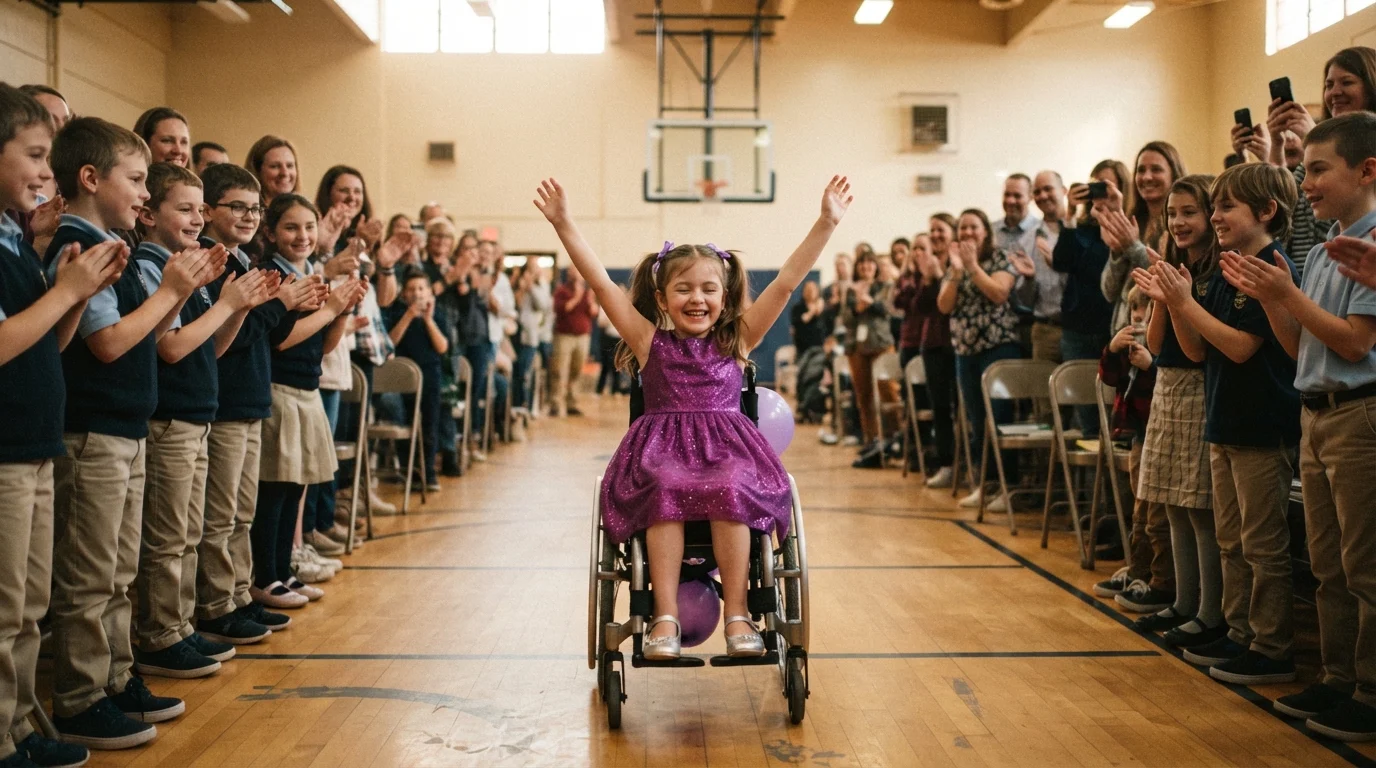
Near the end came Chloe’s favorite part. Her classmates formed two lines, and she rolled between them while everyone clapped to the beat. She stopped in the center, raised both arms, and the whole class froze. The gym went silent for one second.
Then the music ended, and everyone stood. The applause was huge. Chloe looked shocked, then thrilled. Rachel cried, and so did Marcus, wiping his face with his good arm.
Afterward, Chloe rolled straight to him. She reminded him that he pushed her and that her elbow hurt. He apologized. She thought about it and decided the light would have hurt worse. Then she asked for a hug, and Marcus checked with Rachel before giving her one.
Later, Chloe shared what she whispered to him. She had thanked him for not letting her get squished during the wheelchair dance.
Life After the Wheelchair Dance
The school paid to repair Chloe’s chair, and she had it back two weeks later. The wheelchair dance became a turning point, though not because her grief disappeared. There were still bad days, and there still are.
Chloe began learning to use prosthetic legs, but for a long time she preferred her chair because it was faster and more comfortable. Some days she practiced standing. Some days she refused. Rachel stopped treating either choice as a win or a loss.
Months after the festival, Rachel heard music from Chloe’s bedroom. Chloe was in front of the same mirror she once wanted gone, sitting in her chair and moving her arms to the beat. She caught her mom staring and told her to come dance.
Rachel said she couldn’t dance. Chloe rolled her eyes and reminded her that was exactly what she used to say. So Rachel joined her daughter’s bedroom wheelchair dance. She was terrible, Chloe told her so right away, and they danced anyway.
What Chloe Taught Her Mother
Chloe is ten now. She has tried adaptive dance classes, wheelchair dance, and a little gymnastics. She quit one class because the instructor kept calling every move she made “inspiring.” Chloe didn’t want to be inspiring. She wanted someone to say her turn was good. So they found a new teacher.
Marcus still works at the school. Every fall festival, Chloe asks if the lights are safe, and he tells her he checked twice. Last year, she told him to check three times. He did.
Rachel often thinks about how quickly she misread those few seconds. A man grabbed her and then knocked her daughter out of her chair. Out of context, it looked like harm. In truth, he was trying to keep them both alive.
She also thinks about the months before that day, and how much she wanted to shield Chloe from pain. Some of that protection was needed. Some of it was simply fear dressed up as responsibility. Chloe never needed a promise that nothing bad would happen again. She needed room to learn that losing her legs changed how she danced, not whether she could.
If your family is navigating limb loss, the Amputee Coalition offers trusted resources and support. For more real-life stories about family, change, and resilience, visit Divorce Matters Today.
The first performance ended with broken glass and an ambulance, and the second ended with a standing ovation. But the moment Rachel treasures most is quieter: Chloe alone with her music, smiling into the mirror, proof that every wheelchair dance she does now belongs to a girl who became a dancer again.