Braille Memory Box: A Friend’s Heartbreaking 32-Year Gift
Robert was 73 years old when he buried Daniel, the friend he had known since second grade. He left the cemetery that afternoon holding a Braille memory box he never knew existed.
Inside were dozens of envelopes, a small recorder, and a secret his two oldest friends had been carrying without him. What he found changed the way he understood 32 years of friendship.
Three Boys Who Never Learned to Live Apart
Robert, Daniel, and Michael met as little boys in second grade. They learned to ride bicycles side by side and later stood next to each other at their weddings.
Somewhere along the way, the three of them grew old together. None of them could have guessed that so much of their life would one day fit inside a Braille memory box.
A Friendship That Refused to Let Him Disappear
Thirty-two years earlier, when Robert was 41, an accident took his sight. For months, he could barely get out of bed.
Daniel and Michael would not let him fade away. They took him fishing, drove him to family gatherings, and described sunsets he could no longer see.
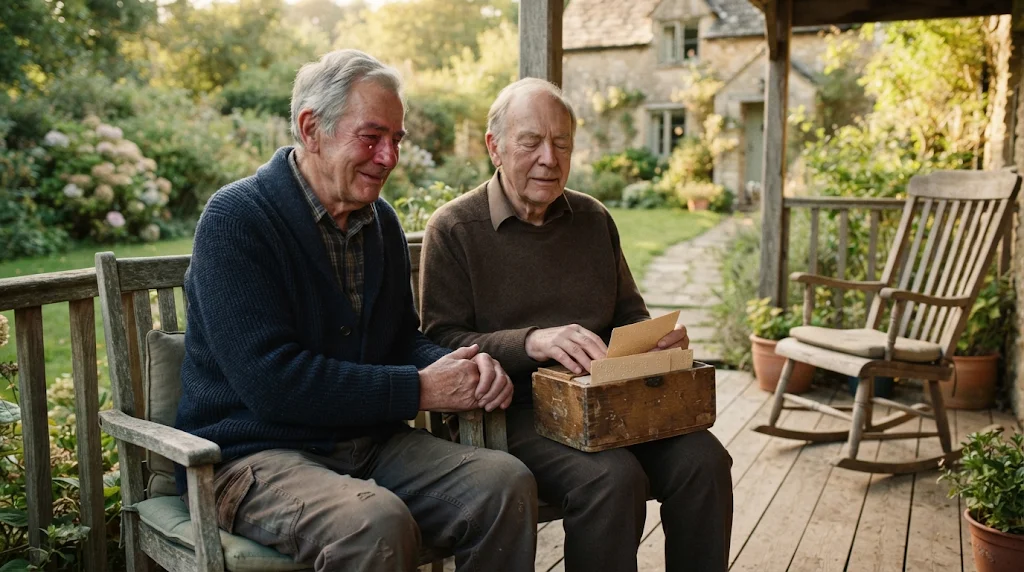
Sunday afternoons on Daniel’s porch became their tradition. For more than three decades, they almost never missed one.
Robert was grateful, but a quiet fear never left him. He worried that he had become a burden.
Some days, when he heard Michael’s car pull into the driveway, he wondered if his friend came because he wanted to or because he felt he had to. Long before anyone handed him a Braille memory box, that doubt followed him everywhere.
The Photograph at the Graveside
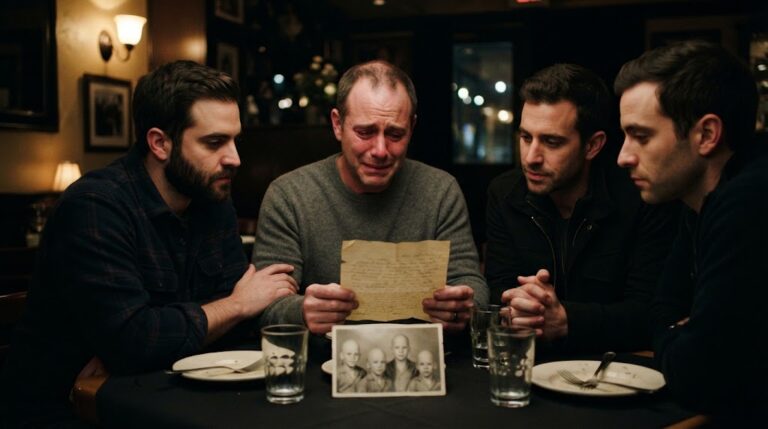
At Daniel’s funeral, Michael brought an old photo. It showed the three of them at age 12, sitting on a wooden bench, with Daniel in the middle.
Michael told the mourners, his voice trembling, that Daniel had always wanted them to recreate that picture. They kept putting it off, sure there would be more time.
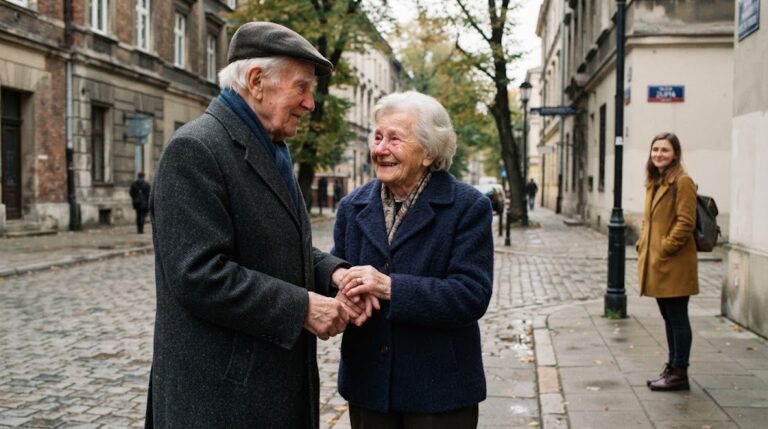
So the two surviving friends stood on either side of the headstone. Michael gently placed Robert’s hand on the cold stone, and Robert traced Daniel’s name with his fingertips.
Beside him, Michael began to cry. Robert reached for him, and they held each other, just two of them now for the first time since they were seven.
When someone offered to take their picture, neither man could speak. They simply nodded.
The Gift Daniel’s Wife Had Promised to Deliver
Then Daniel’s wife came over and pressed something heavy into Robert’s hands. She explained that Daniel had spent the last 32 years making it for him, and she had promised to give it to him that day.
She told him Daniel wanted him to know how much he meant to him. Robert tried to thank her, but his voice broke, so she hugged him instead.
Michael drove him home from the cemetery and made coffee. Robert sat at the kitchen table with the Braille memory box resting on his lap.
It was small, with a smooth lid and worn corners. When he lifted it, his fingers found envelopes, dozens of them, each covered in raised dots.
Daniel had learned Braille shortly after the accident. Over the years, he often left little notes for Robert on his kitchen table, long before he started filling a Braille memory box.
What the Braille Memory Box Was Trying to Tell Him
The first card said that Michael had been afraid to tell Robert something. The next explained that Daniel had promised to stay quiet until Michael was ready, and Michael had finally agreed.
Robert turned toward his friend and asked what he had been hiding. Michael shifted in his chair and, with a shaking voice, told him to keep reading.
The next card asked Robert to think about the last few months.
Daniel had grown weaker, and their Sundays had moved from the porch to the kitchen table. But Michael had been acting strangely too.
One Sunday, Michael asked whether Robert’s granddaughter had started school yet. Robert laughed and reminded him she was 14. The following week, Michael asked the same question.
Robert remembered how Daniel sometimes answered for Michael. He remembered Daniel gently reminding him of things they had discussed only minutes before.
At 73, Robert had brushed it off as ordinary aging. But there was more.
A few weeks before Daniel died, Michael missed their Sunday gathering for the first time in years. When Robert called, Michael sounded confused and said he thought Sunday was the next day.
Robert laughed it off. Daniel didn’t laugh, and he stayed unusually quiet for the rest of the afternoon.
Each card in the Braille memory box pulled one of those small moments back into focus. Robert finally asked if Daniel was trying to tell him something about Michael’s memory.
The kitchen went silent. Then Michael whispered that there was something else in the box.
Remember the Wooden Bench
The next envelope in the Braille memory box carried four words from Daniel: “Remember the wooden bench.”
When the boys were 12, Michael’s mother took him into town one Saturday. She stopped near a small park and told him to wait on a wooden bench while she went to buy something.
Michael waited one hour, then two. By the time Robert and Daniel found him, the stores were closing, and he was sitting perfectly still, insisting his mom was on her way.
They sat beside him for another hour before Daniel ran to get his father. By nightfall, the adults learned that Michael’s mother had left town and was never coming back.
Michael went to live with his aunt a few streets away. The next morning, the three boys had agreed to meet at the same bench.
Michael arrived far too early. When he saw his friends coming, he jumped up so fast he nearly fell, amazed that they had shown up, and then quietly cried into his sleeves.
Robert grabbed his hand and made a promise. If one of them ever got lost, the other two would come looking.
Daniel nodded and added that they would come even if the lost one told them to go away. Michael laughed through his tears, the boys shook hands, and Daniel’s father took the photograph.
For 61 years, that picture was Robert’s favorite childhood memory. He had never understood why Michael was smiling so hard, until the Braille memory box gave him the rest of the story.
The Diagnosis Michael Had Been Hiding
Daniel wrote that Michael had recently shared something about that morning. He still remembered the sound of his two friends running toward him.
Robert smiled. Michael never forgot the things that mattered.
Then his fingers found the next line. Michael was terrified that a day would come when he couldn’t remember them at all.
The last card in that part of the Braille memory box held three words: “Let him explain.”
Michael took a breath, then another. He said he had been seeing a doctor.
He had started forgetting little things the year before. Then he began losing whole conversations, and once he drove to the store with no idea why he had gone.
The doctors ran tests. In the silence, Robert could hear only the clock ticking on the wall.
Then Michael said it. He had Alzheimer’s.
Robert couldn’t speak. Michael had always been the one who remembered everything, from their old teachers’ names to every embarrassing moment since second grade.
When Robert lost his sight, Michael had described the world for him. Now Michael was losing pieces of his own.
He had known for four months. He wanted to say something, but Daniel was dying, and he couldn’t bear to tell Robert he might lose him too.
Robert squeezed his hand and reminded him that he was still right there. Michael said he knew.
Then Michael confessed something that frightened Robert even more. He couldn’t remember what Daniel had said to him the day before he died, and there was no one left to ask.
He could still picture the bench and hear his friends running toward him. But he wondered what would happen if one day he couldn’t.
Robert had no answer. So Michael guided his hand back toward the Braille memory box.
Thirty-Two Years of Ordinary Moments
Beneath the envelopes, the Braille memory box held a small recording player and dozens more Braille cards. Each one carried a date.
The first read “June 1994. Michael’s birthday.” Robert remembered that fishing trip, when Michael fell into the lake trying to rescue Daniel’s hat.
He pressed play, and Daniel’s voice filled the kitchen, teasing Michael about his soaked pants. A much younger Michael insisted the fish had pulled him in, and all three of them burst out laughing.
Beside him, Michael let out a soft laugh. He admitted he had forgotten that day, but he remembered how happy they had been.
Robert kept pressing buttons. There was his granddaughter’s seventh birthday, Daniel describing a sunset from the porch, and Michael laughing at one of Robert’s terrible jokes.
Robert had known Daniel made recordings after the accident to help him hold on to moments he couldn’t see. He never imagined how many there were, or how carefully the Braille memory box had been organized.
Daniel’s Last Letter Inside the Braille Memory Box
At the very bottom, Robert found one thicker envelope. Inside was a letter from Daniel.
Daniel wrote that after the accident, Robert had confessed he was afraid of forgetting their faces. So Daniel began writing things down, like the color of Michael’s new fishing hat and the way Robert’s granddaughter smiled after losing her first tooth.
Later, he started recording their conversations too. Every year, he added a little more, hoping the Braille memory box would always give Robert a way back to the world he used to see.
Then Michael told Daniel about his diagnosis. Daniel realized the memories he had saved for Robert over 32 years might be something Michael needed as well.
He wished he could sit with them and tell those stories himself. Since he couldn’t, he was leaving them with the one person who knew their lives as well as he did.
Daniel closed by reminding Robert of the promise they made at 12. Michael might need Robert to come looking now, and Daniel knew he would be there.
Michael quietly said that Daniel had told him he was making something, but he never knew how much had been saved. Robert pressed play again, and the laughter of three old friends filled the room.
When the Helper Becomes the Helped
Michael asked what would happen if things got worse. What if he forgot their Sundays or kept asking the same questions?
Robert said he would answer them, every time he could.
Then Michael asked what would happen if he forgot Daniel. That question nearly broke Robert, because he couldn’t promise it wouldn’t happen.
But he could promise something about himself. He reminded Michael that for 32 years, he and Daniel had guided him through a world he couldn’t see, and now it was his turn.
Michael wept and said that at 12, he had been afraid no one would come back for him. Now he was afraid he wouldn’t remember when they did.
Robert told him he would remind him, and he would keep telling him about Daniel, the bench, and all their Sundays, using every card and recording in the Braille memory box. Michael didn’t have to remember everything for Robert to keep loving him.
The two men held each other, just as they had as boys. For decades, Robert feared Michael visited out of pity, but the Braille memory box taught him something else.
Sometimes people show up simply because they love you. They come even when there is nothing they can do to save you.
Sunday on Daniel’s Porch
Last Sunday, Robert and Michael sat on Daniel’s porch again, because his wife had told them to keep coming. Daniel’s chair stood empty.
Between them rested the Braille memory box, which Michael had asked Robert to bring. For a while, they just listened to the birds.
Then Michael took Robert’s hand and asked him to tell the story of the photograph from when they were boys. So Robert told him about the bench, the mother who never returned, and the two friends who came running the next morning.
Michael listened and said he remembered. After a pause, he asked what would happen if someday he didn’t.
Robert held his hand a little tighter and gave him the only answer that mattered. He would tell him again.
What This Braille Memory Box Teaches Us About Love
Memory loss doesn’t only affect the person who receives the diagnosis. It touches every friend and family member who has shared their life with them.
Small signs, like repeated questions or a missed routine, are easy to dismiss as normal aging. The Alzheimer’s Association offers a helpful guide to the 10 early signs and symptoms of Alzheimer’s for anyone worried about someone they love.
If this story moved you, you can find more true stories about love, loss, and family on Divorce Matters Today.
In the end, Daniel’s Braille memory box was never really about the past. It was a final act of friendship, making sure that whoever forgot first, the others would still come looking.