Hospital Bench: 2 Coffees and a Father’s Emotional Apology
Every morning before her shift, Noemi carried two cups of black coffee to the old man on the hospital bench. He never once said thank you, and somehow that became part of the charm.
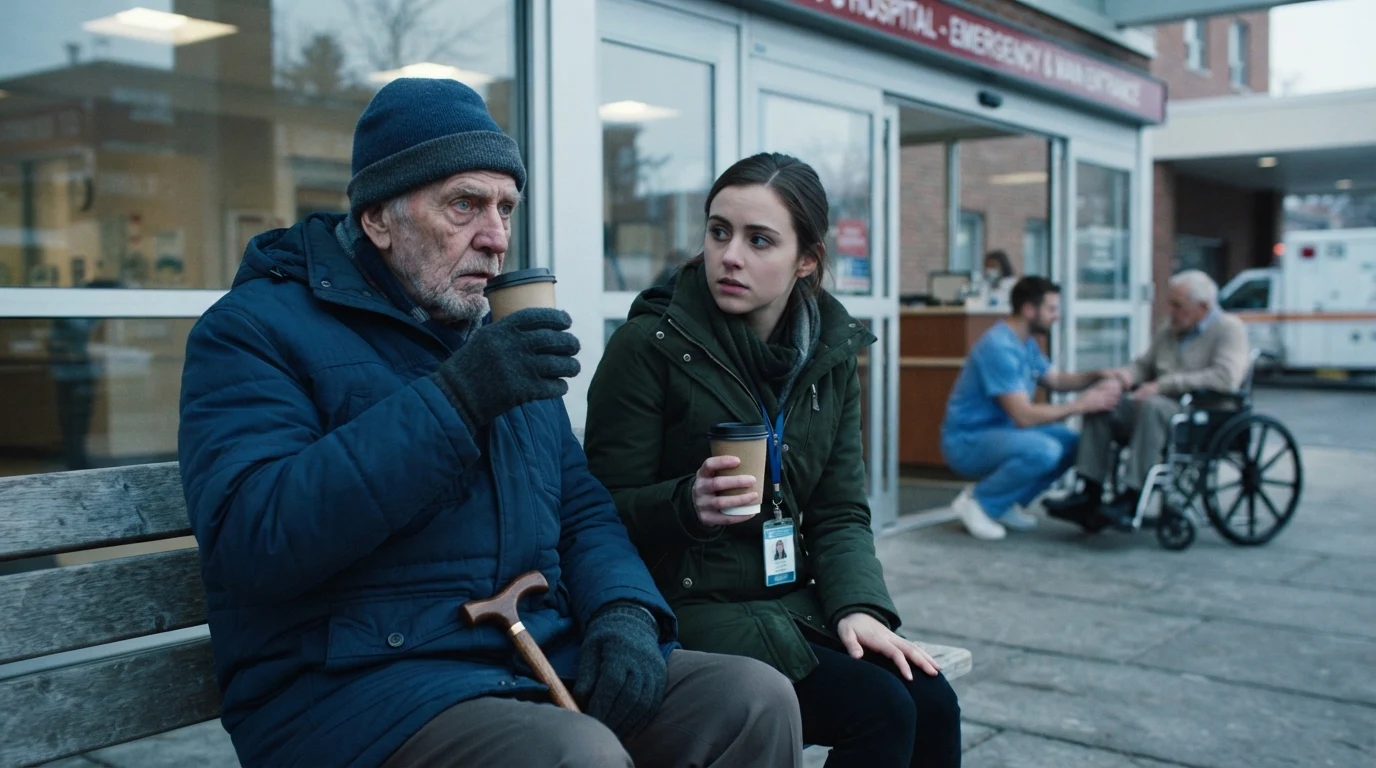
His name was Chad. He wore a blue coat, kept a cane close by, and always slid over to clear a space for her before she sat down.
Noemi had been a nursing assistant at the hospital for only three weeks when she bought him that first cup. Within days, coffee on the hospital bench had become a routine neither of them ever talked about.
A Grumpy Man and a Warm Cup of Coffee
One Friday, Noemi left a pair of gloves with him. The next time she saw him, he was wearing them.
She knew better than to say anything. If she did, he’d have a smart reply ready.
So she just handed him his coffee. He told her she ought to zip her coat.
She asked if that was his idea of a thank-you. He said it was his idea of a zipper. She zipped it, and only then did he take his first sip.
Moments like that reminded Noemi of her grandfather. On Saturdays she used to sit with him on his porch while he looked out at the garden. He’d complain that she talked too much before breakfast, then quietly turn his good ear toward her.
Once she showed up in tears after a fight with her best friend. He grumbled about the noise and went inside, and she thought she’d worn out her welcome.
Then he came back carrying the quilt from his own bed. He tucked it around her feet and sat with her until noon.
The man on the hospital bench, she realized, loved people the same way. Not with words, but with small, stubborn acts of care.
Who Was He Waiting For on the Hospital Bench?
One morning Noemi asked if he ever got tired of staring at the hospital entrance. Chad kept his eyes on the sliding glass doors.
He said there was someone he hoped to see. When she asked if he knew what time they’d come, he answered, “Most days.”
The next morning he was retelling a familiar story about his wife and the three sugars she used to put in her coffee. Then he stopped mid-sentence.
Noemi followed his gaze into the lobby. Two doctors stood near the elevators. A family was coming through the doors. A male nurse was crouched beside a man in a wheelchair, turning him gently toward the woman he was speaking to.
The woman started to say something, then stopped. The nurse didn’t move or hurry anyone. He simply let the man finish.
When Noemi looked back, Chad’s cup had stopped halfway to his mouth. He looked ready to stand, though he hadn’t put down his coffee or reached for his cane.
She asked who he was looking at. By then the elevators had opened, the family had crowded through, and the moment was gone.
Chad said only that it was nobody he knew how to talk to yet. One look at his face told her not to push.
Inside, as she straightened her badge in the glass, Noemi noticed something. From where she stood, she could see him as clearly as he could see her.
A Year of Mornings Watching the Doors
At work, Noemi asked a woman on her floor about the man in the blue coat. The woman knew right away who she meant.
He’d been sitting out there for over a year, she said. At least since last winter.
That changed everything for Noemi. Nobody waits a whole year for a patient or a visitor. Whoever Chad watched from the hospital bench had to work inside, either one of those doctors or the patient nurse.
The next morning, she almost asked him outright. But he was struggling to get the lid off his coffee with his gloves on.
She loosened it for him and asked if he wanted her to stay a little longer. He patted the seat beside him, and she stayed until she had two minutes left to get upstairs.
The Morning the Hospital Bench Sat Empty
The next time she came, the hospital bench was empty. Noemi waited with both coffees until she had to go in.
The following morning, she bought two again. She had just set his cup on his end of the bench when a nurse came out and asked if she was Noemi, the woman who brought Chad coffee.
Noemi picked up the cup and asked if he was okay. The nurse hesitated just long enough for her to fear the worst.
Then the nurse touched her arm and brought her inside. Chad had been admitted a few days earlier, she explained. He hadn’t wanted Noemi to worry, but every morning he asked whether “the coffee girl” had come.
Noemi set both cups down on a table. She’d been annoyed with him for disappearing, and scared she’d never see him again.
The nurse had told Chad the day before that Noemi was waiting outside. His reply was to tell her he still wasn’t thanking her. Noemi laughed before she could stop herself, and a few tears came with it.
Then the nurse said there was something else. Chad had left something for her.
A Brass Key and Two Lines That Hurt
Chad was asleep when they reached his room. His blue coat was folded over the arm of a chair, and on top sat an envelope with her name printed across it in big letters.
Inside was a brass key taped to a folded page. The note gave his address and sent her to a dresser in his bedroom.
The last two lines made her sit down. Chad wrote that his son would say he didn’t want it, but Chad had once told him it wasn’t his anymore. That was what he needed to put right.
Noemi didn’t want to follow the instructions without understanding them, so she waited for him to wake up.
When he did, he told her his son was at the house, packing his clothes for a care home. His son had made it clear Chad wouldn’t be staying with him.
Chad had asked him to look in the drawer. His son said he was only there for clothes and hung up.
Chad suggested she say she’d come for his gray sweater. Noemi refused to lie. She’d tell his son Chad had sent her, because he deserved to know that much.
After a moment, Chad nodded. Top drawer, he said, in a sock pushed all the way to the back. Then he wrote his son’s name at the bottom of the note: Daniel.
The Nurse at the Door
A car sat in the driveway when Noemi arrived after work. A man in jeans opened the door with a roll of packing tape around his wrist.
When he bent to see her past the screen, she recognized him at once. He was the nurse who had crouched beside the man in the wheelchair.
Three bags lay open on the living room floor. Daniel was folding his father’s shirts, undoing the top buttons first.
When Noemi said she’d come for what Chad had asked about on the phone, Daniel stopped folding. He’d told his father he wasn’t doing that today.
She explained that she worked at the same hospital, and that his father sat on the hospital bench outside, waiting to see him. Daniel didn’t buy it. He’d noticed Chad out there in December and assumed his father was waiting for Daniel to give in first.
When Noemi told him it had been over a year, Daniel sank onto the arm of the couch.
Then he told her what happened. Years earlier, Daniel had told his father he’d chosen nursing. Chad called it weird and said a man ought to be a doctor.
Daniel had explained that he wanted to be the person at the bedside. Chad said that if he couldn’t take the pressure, he should admit it, and he wanted Daniel to withdraw his application.
Daniel asked her to leave. As she reached the door, he said quietly that his father never could stand to look at him in scrubs.
The Watch Hidden in a Sock
Noemi stopped in the hall. She pictured Chad outside, his coffee forgotten, lips parted, waiting for his son to stand up so he could see him better.
She could see the dresser through the open bedroom door. She went in and pulled at the top drawer until it came loose, then felt for the sock.
Daniel appeared in the doorway, breathing fast, reminding her he’d told her to go. She apologized, stepped back, and opened her hand.
In her palm lay a watch with a worn brown strap.
Daniel’s eyes went straight to it. After a minute he took it and turned it over. Engraved on the back was a message to his son, telling him his dad was proud of him.
Chad had given it to him when he graduated high school. The night Daniel told him about nursing, Chad held out his hand and waited for him to take it off. When Daniel asked why, Chad said he’d given that watch to a son he was proud of.
Daniel’s voice held until he looked down again. Then he pressed the heel of his hand hard against one eye.
Noemi told him the one thing she’d seen and he hadn’t: his father in the lobby, watching him listen to a man in a wheelchair. She told him Chad loved him and asked him to give his father a chance to explain.
Daniel picked up his keys and said they would go together.
From the Hospital Bench to the Bedside
Chad had his glasses on and was going through the packing list Daniel had printed. He put it down when he saw who was with her.
Daniel set the watch on the tray. He asked whether taking it back meant they’d pretend Chad had never said those words. Chad said no. He’d only hoped that returning it would let them put that night behind them.
Daniel picked up the watch and turned toward the door. Chad asked him to wait.
Then Chad said what he should have said years ago. He admitted he’d taken the watch because he knew it would hurt, and he told Daniel he was sorry.
Daniel asked why he’d spent so many mornings on the hospital bench. Chad said Daniel’s mother used to tell him how Daniel was getting on. After she died, he heard things here and there, and one morning he went down meaning to walk in and say hello.
He kept thinking Daniel would come out. Every day he tried to plan what he’d say, and he never got past hello.
Daniel asked if his father would say all this if he walked in wearing scrubs tomorrow. Chad looked straight at him.
He talked about the man in the wheelchair who kept losing his place, and how Daniel waited every time. Watching that, Chad said, he’d thought, “There’s my boy.”
He told Daniel he had been proud of him in his scrubs, and that he should have walked in and told him.
Daniel looked at the watch for a long while. Then he put it on.
Two Coffees and a Second Chance
Daniel pulled a chair up to the bed. Chad’s room at the care home would be ready on Friday, and Daniel offered to visit on Sunday after lunch if his father wanted.
Chad said he wanted.
Noemi slipped out while they were still talking.
Two shifts later, she passed Chad’s room on her way to get towels. Through the glass, she saw Daniel in his scrubs beside the bed, the watch on his wrist and two coffees on the tray.
Chad said something she couldn’t hear. Daniel bent forward laughing, and Chad laughed with him. Noemi kept walking.
What the Hospital Bench Teaches Us About Family
Chad’s year on the hospital bench shows that pride and regret can sit side by side for a very long time. One harsh sentence, said in a moment of disappointment, cost a father and son years they can’t get back.
But the story also shows it’s rarely too late to try. Chad didn’t have a perfect speech. He had a watch, a little help from a kind stranger, and the courage to finally say he was sorry.
Daniel’s hurt was real, and he had every right to protect himself. What changed things wasn’t pressure. It was hearing plainly that his father had seen who he was and was proud of him.
If you’re the one sitting on your own hospital bench, waiting for the right words, you’re not alone. The Greater Good Science Center at UC Berkeley has a thoughtful piece on how estranged parents and adult children can heal. For more stories about family, relationships, and starting over, visit Divorce Matters Today.
Sometimes all it takes is a cup of coffee, someone who cares, and the nerve to finally get up from the hospital bench and walk through the door.